Dante Alighieri: The Poet Who Walked Through Hell to Find Heaven
A journey through the wounds that became windows into the divine

Jaap Verbeke
Author’s Note:
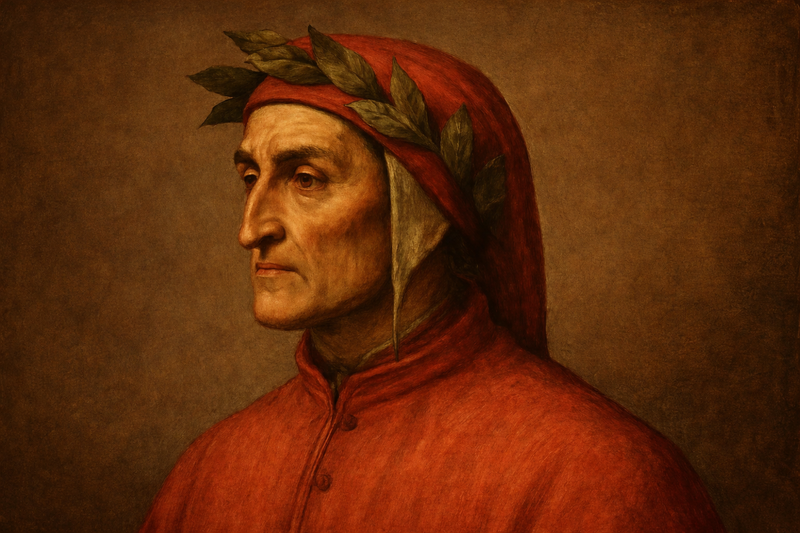
Few writers have explored the human condition with such depth and clarity as Dante Alighieri. Exiled from his homeland and haunted by the death of the woman he loved, he turned his suffering into one of the most enduring works ever written. The Divine Comedy is not only a journey through the afterlife; it is a journey through the soul, through loss, pride, hope, and the slow rediscovery of grace.
“The wound is the place where the light enters you.” - Rumi
A Life Marked by Exile and Vision
Dante Alighieri was born in Florence around 1265, a city divided by power, faith, and ambition. The Florentines were fierce in politics and proud in art, and the young poet absorbed both. He studied philosophy, theology, and classical literature, and became part of the dolce stil novo, the “sweet new style” that treated love as a bridge between the human and the divine.
But Dante’s life was as turbulent as the age he lived in. Caught in the political feud between the Guelphs and Ghibellines, he was eventually banished from Florence. He would never return. Exile stripped him of status, home, and belonging, yet it also gave him what comfort never could: vision.
The Loss of Beatrice: Grief as Illumination
At the heart of Dante’s poetry was Beatrice Portinari, the woman who became his lifelong muse. Their meetings were few, their words scarce, but her presence filled his imagination. When she died in 1290, Dante’s world collapsed. Yet from the ashes of grief rose something luminous.
In La Vita Nuova, he began to translate his sorrow into revelation. Beatrice ceased to be only a woman; she became the embodiment of divine grace, a figure of light guiding him toward understanding. Through her, Dante learned that love, when stripped of possession and ego, could become a path to redemption.
Grief, for Dante, was not the end of love but its purification. In losing Beatrice, he found the meaning of longing itself, that deep ache which, when faced honestly, becomes a form of prayer.
The Divine Comedy: The Journey Within
During his long years of exile, Dante began his masterpiece: The Divine Comedy. It tells the story of a soul lost in darkness who descends into Hell, climbs the mountain of Purgatory, and finally reaches the light of Paradise. Guided first by the Roman poet Virgil and later by Beatrice, Dante’s alter ego walks through every human condition, from despair to awakening.
But The Divine Comedy is more than a map of the afterlife; it is a portrait of consciousness. Hell reveals what happens when love is corrupted, when pride, greed, and cruelty consume the heart. Purgatory teaches humility and renewal. Paradise reveals what it means to see through the eyes of grace.
In these pages, Dante created a mirror of humanity. Every sin and virtue he described still breathes in us. Every soul he encounters is a reflection of our own unfinished story. That is why his poem, seven centuries later, still feels intimate.
The Poet Who Forged a Language
Before Dante, Italy was a patchwork of dialects. Latin was the language of scholars; the vernacular was considered unworthy of serious thought. Dante changed that forever. He wrote his masterpiece in Tuscan - the language of the people - and in doing so, he elevated everyday speech into art.
That choice reshaped history. Tuscan would later form the foundation of modern Italian, and Dante would be called il Sommo Poeta, the Supreme Poet. Through him, a divided land found a common voice.
He also invented terza rima, a chain-link rhyme that binds every stanza to the next, mirroring how each human act leads inexorably to another. His structure itself became philosophy, the form and meaning inseparable.
Legacy and Illumination
What makes Dante’s work timeless is not its theology, but its humanity. He understood that suffering refines the soul, that love, when freed from self-interest, redeems, and that language can illuminate what lies beyond reason.
The Divine Comedy reminds us that every life is a pilgrimage. Each of us, in our own way, walks through infernos of loss, purgatories of learning, and fleeting glimpses of paradise. The journey is inward, the destination, light.
Dante’s life was marked by exile and heartbreak, yet he turned both into revelation. His genius lies not only in what he wrote but in what he became, proof that art, born of pain, can transform despair into beauty.
For You to Contemplate
• What personal “exile” has shaped the way you see the world?
• How can love - even when lost - become a teacher?
• In what ways can art or reflection redeem suffering?
• What would it mean to walk through your own darkness and find light on the other side?

Comments
No comments yet. Be the first to comment!