James Brooke: The Adventurer Who Became the White Rajah of Sarawak
An Unlikely King in the Age of Empire

Author’s Note:
“A man may shape his own destiny, but he must first have the courage to set sail.” - Anonymous
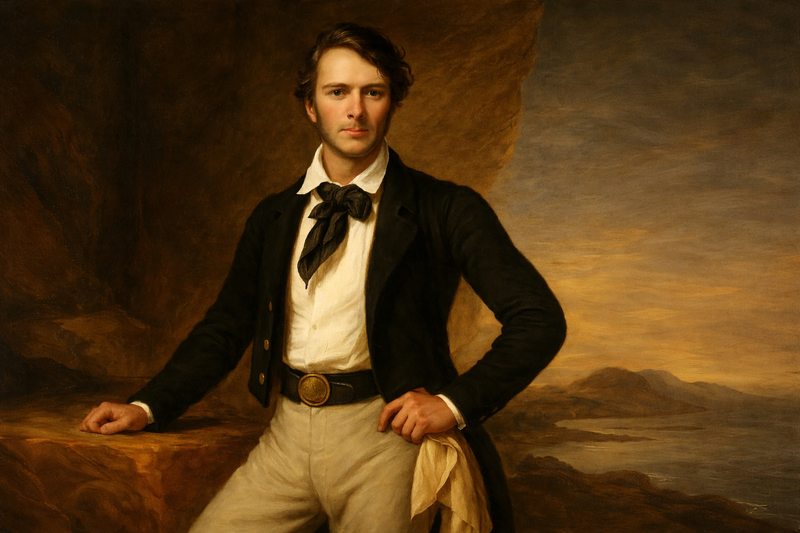
In the early decades of the nineteenth century, when the British Empire’s reach stretched across oceans and the map of Southeast Asia was still a patchwork of sultanates, tribal territories, and pirate-haunted seas, one man carved out a kingdom of his own. James Brooke, an Englishman born in colonial India, was neither a career soldier nor a conventional statesman. Yet through a mix of daring, diplomacy, and sheer persistence, he became the first White Rajah of Sarawak, a ruler in a land far from his birthplace, governing a people whose language and customs he had to learn from the ground up.
His story is not merely one of conquest, but of transformation: a restless young man, shaped by injury and disappointment, who found purpose in the unlikeliest of places.
Early Life in a Changing World
James Brooke was born on 29 April 1803 in Secrore, near Benares (now Varanasi), India, during the height of the British East India Company’s influence in the subcontinent. His father, Thomas Brooke, was an English judge in the Company’s service, and his mother, Anna Maria, the daughter of a Scottish nobleman.
Brooke’s early years were shaped by the sights, sounds, and contradictions of colonial India, a world where British authority coexisted uneasily with ancient traditions. At twelve, he was sent to England for schooling. The transition from India’s vibrant landscapes to the grey restraint of England was jarring. He attended Norwich School and later the Royal Military College at Sandhurst, but illness and injury interrupted his studies. Even as a boy, he was restless, drawn to adventure and the romance of far-off places.
Soldiering and Setbacks
In 1819, at just sixteen, Brooke joined the Bengal Army of the East India Company. His early military career took him into the First Anglo-Burmese War (1824–1825), a brutal campaign fought in the jungles of Southeast Asia. There, he was severely wounded, an injury that ended his active service.
Returning to England to recover, Brooke found himself adrift. He had tasted the thrill of distant lands but was now confined to a quieter life. Yet the pull of the East never left him. He read widely about exploration and trade, dreaming of returning, not as a soldier, but as an independent adventurer.
The Call of the Archipelago
In 1834, Brooke attempted a trading voyage to the Eastern Archipelago, but it ended in disappointment. Undeterred, he invested his inheritance in a schooner, The Royalist, and in 1838 set sail again, this time with a crew and a clearer purpose.
Arriving in Singapore, he learned that Pengiran Muda Hassim, the chief minister of Brunei, was struggling to suppress a rebellion in Sarawak, a territory on the northwest coast of Borneo. Sarawak was nominally under Brunei’s control but plagued by unrest among the local Dayak and Malay populations. Brooke offered his assistance, bringing his ship, his men, and his sense of destiny.
The Making of a Rajah
Brooke’s intervention proved decisive. By 1841, the rebellion had been crushed, and in gratitude, Muda Hassim offered him the governorship of Sarawak. The following year, the Sultan of Brunei formally confirmed Brooke’s position, granting him the title of Rajah. Thus began the Brooke Raj, a singular political experiment in which a British adventurer ruled an Asian state as an independent monarch.
As Rajah, Brooke sought to impose order. He worked to suppress piracy, which plagued the surrounding seas, and to curb headhunting among the Dayak tribes. His rule blended British administrative methods with a respect for local customs, earning him both admiration and suspicion.
Power, Challenges, and Legacy
Brooke’s reign was not without controversy. His anti-piracy campaigns drew criticism in Britain, where he was accused of using excessive force. He was investigated in Singapore but ultimately cleared of wrongdoing. Despite these challenges, he maintained his authority and expanded Sarawak’s territory.
He also faced internal threats, uprisings and political intrigue in Brunei, yet through diplomacy, military resolve, and personal charisma, he held his ground. By the time he returned to England in 1863, leaving his nephew Charles to govern, Sarawak had evolved from a troubled outpost into a stable, internationally recognized state. He died in Devon in 1868, leaving behind a dynasty that would endure for a century.
Reflective Commentary
James Brooke’s story is one of ambition, resilience, and the uneasy meeting point between personal vision and imperial politics. He was neither a typical colonial governor nor a purely selfless reformer. His rule was paternalistic, sometimes autocratic, yet marked by genuine attempts to improve the lives of his subjects.
Brooke’s life invites reflection on the nature of leadership. He stepped into a power vacuum and filled it with his own ideals, for better or worse. His legacy reminds us that history is rarely clean-cut: one person’s hero is another’s opportunist. True leadership often emerges in the space between ambition and service. Brooke’s life shows that vision, courage, and adaptability can alter the course of history, but that power always carries moral complexity.
For You to Contemplate
Can leadership born from ambition still serve the greater good?
How do we judge historical figures who acted within moral landscapes unlike our own?
Is it possible to blend respect for local traditions with foreign governance?
What does it mean to “civilize” in the eyes of history, and who decides?
Epilogue: The Wake of a White Rajah
James Brooke’s life reads like a sea-worn journal, part adventure, part political intrigue, part personal quest. From the boy in colonial India with restless eyes to the wounded soldier in search of purpose, to the man who carved a realm in the steaming jungles of Borneo, his journey was as unpredictable as the waters he sailed.
He left behind a Sarawak forever changed, a dynasty that would endure for a century, and a legacy that still stirs debate. Was he a visionary reformer, a benevolent autocrat, or simply a man who seized an opportunity and refused to let go? Perhaps he was all of these at once.
What is certain is that Brooke’s story reminds us that history is shaped not only by empires and armies but by individuals willing to step beyond the known world and stake their lives on a dream. In the end, the Rajah of Sarawak was not just a ruler of land, but a navigator of human possibility, charting a course between cultures, ambitions, and the tides of his own time.

Comments
No comments yet. Be the first to comment!