Rethinking the Primitive
What So-Called “Simple” Societies Reveal About Wealth, Work, and Human Presence

Author’s Note:
This essay arose from a long-standing discomfort with the term “primitive”. It is a term that says more about the observer than the observed. My first encounter with Marshall Sahlins’ Stone Age Economics gave that discomfort intellectual grounding. Shortly after, time spent among the Mentawai people of Siberut gave it flesh, laughter, and memory. What follows is not nostalgia, nor a call to abandon modern life, but an attempt to think more honestly about what we mean by progress, wealth, and civilization.
“The world’s most primitive people have few possessions, but they are not poor. Poverty is not a certain small amount of goods, nor is it just a relation of inequality. Poverty is a social status. As such, it is the invention of civilization.” - Marshall Sahlins, Stone Age Economics
Rethinking the Primitive
When Stone Age Economics was published in 1972, it quietly overturned one of the most deeply held assumptions of modern life: that material accumulation is the natural measure of wealth. Marshall Sahlins did not merely analyze hunter-gatherer societies; he exposed a cultural illusion at the heart of industrial civilization.
His most provocative claim was simple and unsettling. So-called “primitive” societies were not poor. They were, in fact, the original affluent societies.
Affluence, Sahlins argued, is not a function of production. It is a relationship between desire and sufficiency. By that measure, many hunter-gatherers lived richer lives than we do now: working fewer hours, meeting their needs reliably, and devoting far more time to social life, ritual, and rest.
The shock of Sahlins’ work is not historical. It is contemporary. It forces us to ask whether modern scarcity is real or whether we manufacture it and then mistake it for fate.
The Original Affluent Society
In the now-famous chapter “The Original Affluent Society,” Sahlins dismantles the image of early humans as locked in a desperate struggle for survival. Drawing on ethnographic data, he showed that many foraging societies spent only a few hours a day securing food. Hunger was not constant. Leisure was not rare.
They achieved affluence not by producing more, but by wanting less.
This reverses the logic of modern economies. Industrial societies define success through endless expansion, endless innovation, and endless desire. Scarcity becomes permanent because desire has no natural stopping point. In contrast, hunter-gatherer societies lived within an ecology of limits that were understood, respected, and socially reinforced.
From the vantage point of a world plagued by burnout, ecological collapse, and chronic dissatisfaction, Sahlins’ argument reads more like a diagnosis than an anthropological argument.
Economy Is Not Neutral
One of Sahlins’ most enduring contributions was his insistence that economy is not a universal, rational system. It is cultural.
In many small-scale societies, economic life is inseparable from kinship, ritual, and moral obligation. Exchange is embedded in relationships. Value is social before it is material. The gift, not the contract, forms the basis of cohesion.
This directly challenges the modern economic model of the rational, utility-maximizing individual. In enough societies, people act not to maximize profit, but to maintain balance, honor obligations, and affirm belonging. Generosity raises status. Hoarding invites suspicion.
From this perspective, modern economic behavior appears less rational than we assume. Despite unprecedented productivity, inequality grows. Despite rising GDP, well-being stagnates. The models fail because they misunderstand what motivates human beings.
The Spirit of the Gift
In his discussion of reciprocity, Sahlins describes gift economies not as primitive precursors to markets, but as fundamentally different moral systems. Gifts create bonds. They bind people into ongoing relationships of mutual recognition and responsibility.
The value of a gift lies not in equivalence, but in meaning.
This idea feels oddly contemporary. Mutual aid networks, open-source communities, and informal care economies continue to thrive alongside markets, not because they are inefficient, but because they meet human needs that markets cannot. They generate trust, belonging, and dignity.
In a world increasingly mediated by algorithms and impersonal transactions, the persistence of gift-based exchange is a quiet reminder that economy is always, at its core, social.
Lessons From Siberut
These ideas are not abstract to me.
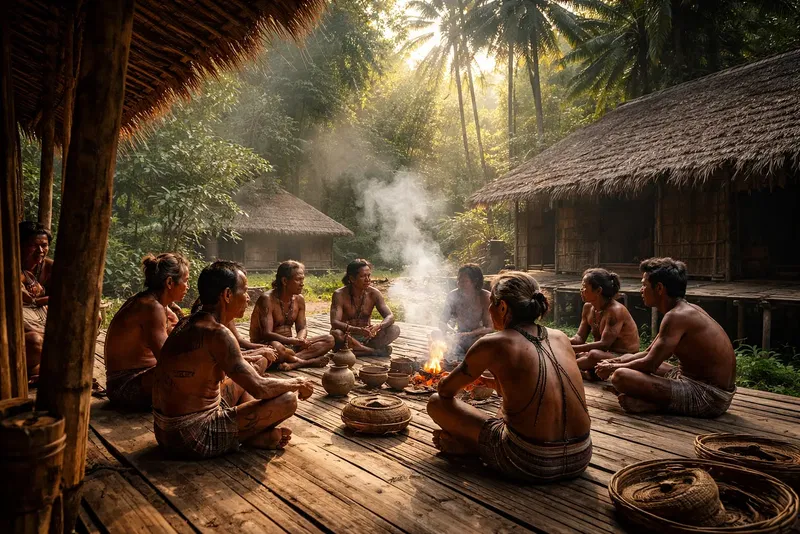
During my time on Siberut, in the Mentawai Islands, I was struck by something that fascinated me. Men and women spent hours sitting on verandas, talking. Not waiting. Not killing time. Simply being together.
Members of other clans would arrive unannounced and stay for hours. Laughter was constant, erupting so frequently it became contagious. This was not ceremony. It turned out, as I realized after some time, to be routine.
What stood out most was presence. When people listened, they were fully there. Fully engaged. Words did not drift past them. They landed. They were absorbed.
An anthropologist named Gigi, who helped me enter this world, once told me a story that crystallized everything Sahlins had tried to explain.
On Siberut, all men were competent in subsistence skills, but some excelled in some skills. Some were exceptional hunters. Others were gifted carvers. You must know that pigs were highly valued and frequently exchanged.
One day, Gigi asked a talented carver named Si-Ta-maila why he did not spend most of his time carving dugout canoes and exchanging them for pigs. After all, pigs were the closest thing the island had to a store of value.
Si-Ta-maila did not understand the question.
Why would he make more dugouts than he needed? He only needed one.
When Gigi explained that this strategy could make him the wealthiest man in the clan, Si-Ta-maila burst into laughter, laughing until tears streamed down his face. The idea was so absurd that it barely deserved a response.
The question itself was the joke.
Civilization and the Invention of Poverty
The Mentawai Islands have since been pulled into the 21st century, reluctantly and violently. Inland populations were resettled by the Indonesian government into coastal nuclear-family housing. It didn’t take long for clans, who understood themselves as collective entities rather than individuals, to return to their ancestral villages.
In response, the military burned those villages after moving the people out.
Large timber companies were granted licenses, accelerating the collapse of Mentawai society. Within a short period, unfamiliar concepts became commonplace: unemployment, alcoholism, prostitution, depression. Scarcity arrived not as a natural condition but as a social, constructed one.
The Mentawai were animists. When a large hardwood tree was cut down to make a dugout, the act was preceded by an elaborate ceremony in which a sapling was brought to the doomed tree, giving its spirit a new dwelling. Against this worldview, the wholesale destruction of the forest was not merely an economic loss. It was spiritual devastation.
This is what Sahlins meant when he said poverty is an invention of civilization. Not because suffering did not exist before modernity, but because modern systems institutionalize lack by severing people from sufficiency, autonomy, and belonging.
Sahlins does not ask us to abandon modern life or return to the forest. He asks something more uncomfortable: to question the assumptions we no longer notice.
What if affluence meant enough rather than more?
What if work served life instead of consuming it?
What if the economy were a tool for relationship rather than extraction?
So-called “primitive” societies are often imagined as rigid, hierarchical, or authoritarian. The Mentawai villages were none of these. They had no chiefs. Authority did not concentrate in human hands. They had shamans, but their influence extended only into the spiritual realm, not into governance or coercion.
This distinction matters.
It reminds us that complexity does not require domination, that order does not demand hierarchy, and that coherence can exist without centralized power.
Learning from such societies does not entail regression.
Most of them no longer exist in any intact form. They were dismantled before we recognized their coherence, before we understood their value. Not because they failed, but because they obstructed.
What remains is not a way of life to return to, but a set of human capacities we have not entirely lost: the ability to recognize sufficiency, to place relationship above accumulation, and to understand that presence itself can be a form of wealth.
Comments
No comments yet. Be the first to comment!