Two Colliding Worlds · Part 8 · Lines That Hold
When preparation replaces debate
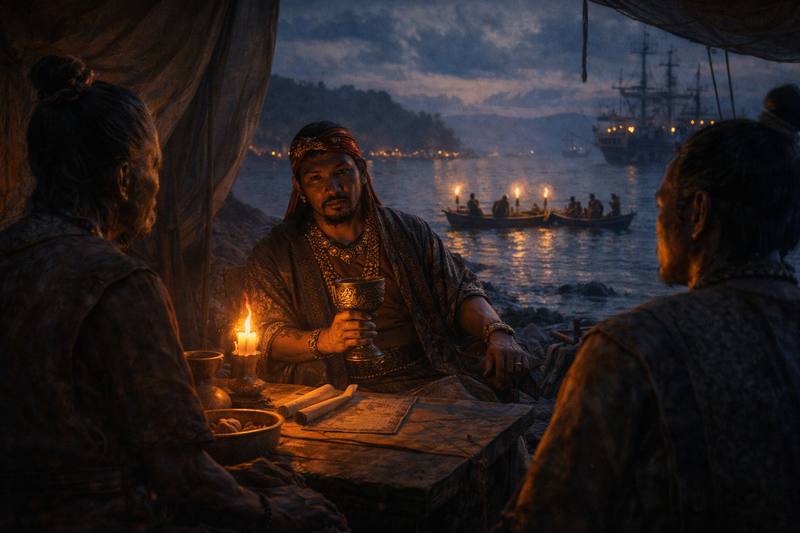

Author’s Note:
There is a moment in every conflict when argument exhausts itself. Not because agreement has been reached, but because further speech no longer changes position. In this episode, the language of persuasion gives way to the language of preparation. No one strikes. No one advances. But the island begins to behave as if the future has already chosen its shape.
Morning arrived without ceremony.
The smoke from the burned hut had thinned, but its presence lingered in other ways. Ash marked doorways. Nets carried the faint scent of it. Dogs moved differently, alert but subdued, as if something in the night had altered the ground they walked on.
On Mangatang, men rose earlier than usual. Not from fear, but from habit reformed. Canoes were pulled higher onto shore. Fishing routes adjusted. Spears leaned closer to the walls, not raised, not hidden.
Preparation had begun to replace discussion.
Lapu-Lapu watched this unfold without comment. He had not ordered it. He did not need to. When a community reached a certain understanding, instruction became unnecessary. People moved according to what they sensed rather than what they were told.
In the council hut, the elders gathered again, though fewer words were spoken now.
“The fires were seen,” one said.
“Yes,” Lapu-Lapu replied.
“The boats remain,” another added.
“Yes.”
“They are waiting,” a third said.
“Yes.”
Silence followed, not heavy, not strained. Simply settled.
“What do we do now,” an elder asked, more from habit than uncertainty.
“We continue,” Lapu-Lapu said. “As we have begun.”
“And if they cross,” the elder pressed.
“Then they cross,” Lapu-Lapu replied. “But we do not.”
That answer ended the discussion.
Across the channel, movement told a different story.
The small boats that had lingered beyond the reef began to change position, not closer, not farther, but enough to register intent. Men stood openly. Cloth marked with Sugbo’s symbols hung where they could be seen clearly from shore.
Signals, not threats.
Humabon listened to reports with satisfaction. He had always understood that power functioned best when it did not need to rush.
“They are preparing,” an adviser said.
“Yes,” Humabon replied. “And by doing so, they admit inevitability.”
“They have not struck,” the adviser noted.
“No,” Humabon said. “Nor should they. First strikes are crude. Much better when others feel compelled to explain themselves.”
“And the foreigners,” the adviser asked again.
“They grow restless,” Humabon said. “Which makes them useful.”
On deck, Magellan watched the channel with increasing irritation. He did not like stalemates. He did not like lines that refused to clarify themselves through action.
“They hide behind patience,” he said.
“They stand behind it,” Enrique corrected.
“A difference without meaning,” Magellan said.
Enrique did not argue. He had learned when language ceased to be effective.
On Mangatang, the babaylan moved through the village, speaking quietly with those who sought her, listening more than answering. She marked places where offerings were left, where patterns shifted, where unease gathered.
“You feel it,” Mayumi said as they walked together.
“Yes,” the babaylan replied. “The island is learning how to hold itself.”
“How long,” Mayumi asked.
The babaylan did not answer directly. “As long as it must.”
That afternoon, Lapu-Lapu sent men to reposition nets near the eastern mangroves. Not to block passage, but to complicate it. Canoes were placed where they could be launched quickly, but not conspicuously. Paths were brushed over. Familiar routes were softened into uncertainty.
Nothing irreversible.
Everything intentional.
The village understood the rule now without hearing it spoken.
Do not cross.
Do not provoke.
Do not pretend.
As the sun lowered, a messenger crossed the channel again.
This time, he did not shout.
He stood in his boat, close enough for his voice to carry without effort.
“Datu Lapu-Lapu,” he called. “The Captain-General wishes clarity.”
Lapu-Lapu stepped to the shoreline, his posture relaxed, his voice even.
“Clarity does not require a journey,” he said.
“The Captain-General offers protection,” the messenger replied. “He offers order.”
Lapu-Lapu nodded once. “Order imposed from outside is only another name for submission.”
The messenger hesitated. “If you refuse, consequences will follow.”
“So will acceptance,” Lapu-Lapu said.
The messenger waited, perhaps hoping for more.
There was nothing else.
The boat turned back.
That evening, the council gathered one last time before night fully settled.
“We are past words,” one elder said.
“Yes,” Lapu-Lapu replied.
“And past welcome,” another added.
“Yes.”
“What remains,” the elder asked.
Lapu-Lapu looked around the hut, at faces he had known since childhood, at men and women who understood what standing meant in ways that did not need explanation.
“What remains,” he said, “is how we stand when others move.”
After the council dispersed, the village did not return to its earlier rhythms.
Men lingered in small groups, not speaking loudly, not arguing. They checked knots, re-counted spears, and adjusted the placement of canoes already pulled high enough to suggest readiness without announcement. These were not drills. No one called them that. They were habits forming in real time.
Women moved between houses carrying food and water, redistributing without instruction. Families that had eaten alone the night before now shared fires. Children were kept closer, not in fear, but in recognition that attention itself had become a form of shelter.
No one needed to be told why.
Along the eastern mangroves, nets were shifted again. Not removed. Not tightened into barriers. Just altered enough that an unfamiliar passage would hesitate. Paths through the brush were brushed over lightly, recognizable only to those who already knew where to step.
The island was not closing itself.
It was learning how to hold.
From the shoreline, the boats beyond the reef remained visible. They did not advance. They did not withdraw. Their stillness was deliberate, a question held in place.
Lapu-Lapu watched them without expression.
Mayumi stood beside him. “They expect us to explain ourselves.”
“Yes,” he said.
“And we will not.”
“No.”
She nodded. “Some will say we should speak again. That silence looks like weakness.”
“Silence looks like weakness only to those who believe words create position,” Lapu-Lapu replied. “We have already spoken.”
As evening approached, a group of younger men approached him hesitantly. They did not bow deeply. They did not posture.
“We want to know where to stand,” one of them said.
Lapu-Lapu looked at them for a long moment. “Stand where you already are,” he said. “And do not pretend you are elsewhere.”
That was enough.
They did not ask again.
Across the channel, movement of a different sort continued. Messages passed quietly between Sugbo and the ships. Men compared notes, not on weapons, but on timing. On whom watched whom. On which fires burned brightest, and which seemed newly placed.
Humabon listened and nodded. “They are behaving as if choice has already narrowed,” he said.
“Yes,” an adviser replied. “They are preparing.”
“Good,” Humabon said. “Preparation makes later justification easier.”
On deck, Magellan watched the island darken into silhouette. He did not like how still it was.
“They think patience is strength,” he said.
Enrique answered without turning. “It is, when it is shared.”
Magellan said nothing.
On Mangatang, the first watch fires were lit.
No signal was sent.
No challenge issued.
But the line was weighted now.
And everyone watching understood it.
The watch fires were lit along the shore. Not bright. Not hidden. Spaced deliberately, where they could be seen by the next and by the water between them.
Across the channel, the lights were seen.
“They have drawn a line,” Magellan said.
“Yes,” Enrique replied.
“And they will not cross it.”
“No,” Enrique said. “But they will make crossing it costly.”
Magellan’s jaw set. “Then we will force them.”
Enrique looked at the water, at how narrow it was, at how much it already carried.
“Forcing is not the same as winning,” he said.
Magellan did not respond.
On Mangatang, the village settled into a new rhythm.
Children were kept closer. Meals were shared more communally. Men rotated watches without being asked. Women prepared supplies quietly, not in panic, but with care.
No one spoke of battle.
Everyone behaved as if it might come.
Lapu-Lapu walked the shoreline alone as night deepened, the water cool against his ankles. He traced a line in the wet sand, then another beside it. Between them, the tide moved in and out, erasing and redrawing.
Lines in water never held.
But some lines were not drawn there.
Behind him, the babaylan appeared without sound.
“The island has chosen,” she said.
“Yes,” Lapu-Lapu replied.
“And others will test it.”
“Yes.”
She watched the tide wash over the marks in the sand. “When they do,” she said, “the line will no longer be yours alone.”
Lapu-Lapu straightened, looking across the channel where lights flickered and shifted.
“I know,” he said.
He did not cross.
And because he did not, the future began to organize itself around that refusal.
To be continued …
________________________________________________________
Terms & Names
Terms
Barangay – A coastal settlement or community, often composed of extended kin groups.
Datu – A local chieftain whose authority rests on lineage, alliances, reputation, and force.
Babaylan – A ritual specialist, healer, and spiritual authority, often serving as intermediary between the human and spirit worlds.
Balangay – A large wooden boat used for trade, travel, and warfare across island waters.
Alipin – A dependent or bonded person; status could vary widely and was not equivalent to later colonial chattel slavery.
Sandugo – A blood compact sealing alliances or agreements between leaders.
Mangayaw – A raid or expedition, often undertaken for prestige, vengeance, or captives.
Anito – Spirits or ancestral beings believed to influence the living world.
Names & Places
Lapu-Lapu – Datu of Mangatang, a coastal leader whose authority rests on independence and control of the reefs.
Humabon – Humabon was the ruler or Rajah of Sugbo when Ferdinand Magellan arrived on April 7, 1521. He entered into a blood compact with Magellan, converted to Christianity, and allied with the Spanish.
Mangatang – The island later known as Mactan; a strategic settlement opposite Sugbo.
Sugbo – A powerful neighboring settlement, later known as Cebu.
Zula – A rival datu claiming influence along Mangatang’s western shore.
Hara – A woman close to Lapu-Lapu, offering counsel, grounding, and presence rather than prophecy.
Kumpar – An older warrior in Lapu-Lapu’s following, marked by experience and a direct view of power and violence.
Banog – A younger warrior, observant and efficient, often tasked with watching rather than speaking.
Duarte Barbosa – An officer serving as a navigator for Magellan and captain of the Victoria.
João Serrão – An officer also serving as a navigator for Magellan and captain of the Santiago.
Bohol (Bool) – An island to the east, known in pre-colonial times as Bool.
Leyte (Tandaya) – An island to the northeast, historically referred to as Tandaya.
Olango Island – an island 5km off the east coast of Mangatang.

Comments
No comments yet. Be the first to comment!