Two Worlds Colliding · Part 2 · Strangers Who Carry Thunder
When the world announced itself before it learned how to listen

Author’s Notes:
This episode shifts the lens away from the island and toward the men approaching it. The fleet does not arrive violently. It arrives confidently. Meaning, in their minds, is portable. It can be carried across water, translated, and applied. The misunderstanding that closes this episode is not dramatic, and that is its danger. Nothing breaks. Nothing is refused. Something simply fails to align.
The ships passed Mangatang without slowing.
From the deck, the island appeared close enough to touch, a low dark shape resting on the water as if it had chosen that position deliberately. The reef showed itself in pale seams beneath the surface, then vanished again as the tide shifted. There were no fires. No boats pushed out to meet them. Nothing announced welcome or resistance.
Magellan studied the shoreline briefly, then turned his attention forward.
Mangatang was not his destination. Sugbo was.
Position mattered. Harbors mattered. Men who controlled trade mattered more than men who controlled reefs. An island that did not announce itself could be dealt with later, once the proper relationships had been established.
Behind him, the fleet creaked and adjusted, sails drawing, hulls responding to familiar commands. The men had settled into the quiet competence of sailors who believed the most dangerous part of their journey was already behind them.
Enrique stood near the rail, eyes on Mangatang as it slid past. He said nothing. Islands like that had a way of remembering being ignored.
From the deck, Mangatang revealed nothing further. No canoes slipped into the water. No figures moved along the shore in ways that could be read as a signal or a welcome. The island seemed to accept being passed without comment, and that silence unsettled some of the men more than open hostility would have. A shore that did not react forced you to supply your own meaning, and meaning, when supplied too quickly, had a way of hardening into error.
Magellan did not linger on the thought. He had learned long ago that attention was a finite resource. To spend it on every uncertainty was to arrive nowhere. Mangatang was close, yes, but closeness alone did not confer relevance. Power announced itself through trade routes, harbors, and men willing to speak their names aloud. An island that waited would continue to wait until summoned.
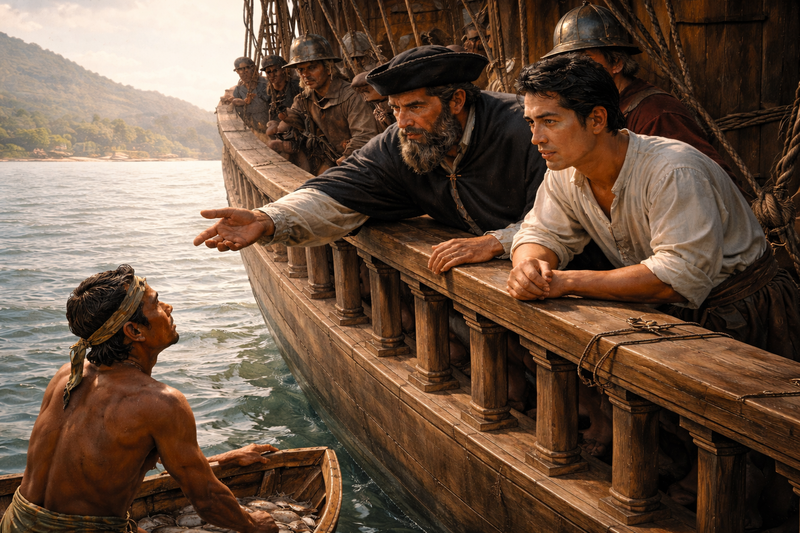
As the ships angled toward the wider opening of Sugbo harbor, movement appeared on the water ahead.
Small boats. Fishing craft. Light, narrow, built for shallow water and daily return. Men stood in them easily, paddles resting against their shoulders, nets coiled at their feet. They did not flee at the sight of the ships. They slowed, watching.
Magellan lifted a hand slightly. The signal passed. The ships eased their approach.
“This is better,” he said. “They trade.”
The fishermen came closer, curiosity outweighing caution. Faces were open, eyes alert. One of them called out, a sentence shaped by the water and distance. The words did not carry clearly.
Enrique listened. He caught fragments, familiar sounds arranged in a way that made sense only if you already belonged to the coast.
“They ask where we come from,” he said.
Magellan nodded. “Tell them.”
Enrique spoke back, choosing his words carefully, simplifying, unaware he was already shaping the exchange toward misunderstanding.
“We come from far away,” he said. “We travel to trade. We seek the lord of this place.”
The fishermen exchanged glances. One of them laughed briefly, not in mockery but in surprise.
Another spoke again.
“They say Sugbo belongs to Humabon,” Enrique translated. “They say he receives visitors.”
Good, Magellan thought. A known authority. A name. That was how order revealed itself.
He gestured, and small objects were brought forward. Not gifts, not yet, but items meant to signal intent. Glass that caught the light. Metal that held it. The fishermen accepted them cautiously, turning them in their hands, testing weight and edge.
One of the fishermen ran a thumb along the rim of a metal cup, then tapped it lightly against the side of his boat. The sound was dull, unimpressive. He glanced at his companions and shrugged, as if to say the object had uses but no voice. They had seen strange things before. Traders passed through Sugbo often enough, each carrying objects meant to impress, persuade, or confuse. What mattered was not novelty, but what followed it.
Enrique noticed how quickly the fishermen’s attention returned to the ships themselves. The hulls. The rigging. The number of men standing idle. They were counting without appearing to, gathering information as coastal people always did. He wondered what conclusions they were already drawing and whether any of them aligned with the assumptions that were forming so confidently behind him.
They did not bow. They did not thank. They nodded, once.
Magellan took this as composure.
The boats lingered alongside for a time, conversation moving in short exchanges, meaning approximated rather than shared. Directions were given with hands and glances. The fishermen pointed toward the inner harbor, then traced a line with their paddles, careful, precise.
“There is shallow water,” Enrique said. “They warn us.”
“We will manage,” Magellan replied.
The fishermen pushed off eventually, returning to their work with frequent backward looks. The ships continued on, guided now by local knowledge filtered through assumption.
As Sugbo opened before them, the harbor revealed itself in layers. Canoes. Smoke. The suggestion of a settlement larger than any they had seen since leaving the islands farther east. The water deepened. The shore grew more articulate, shaped by use and habitation.
Magellan felt the familiar comfort of focus. This was the moment where journeys became encounters.
He ordered the ships to slow and prepare.
Men moved with practiced ease. Lines were checked. Colors readied. Not for battle. For display. An order was something one demonstrated before negotiating.
On Mangatang, watchers followed the fleet’s movement with narrowed eyes.
They did not speak of it as a decision. The ships had chosen their path. The island had not been addressed. That in itself was information.
Lapu-Lapu listened as reports came in, brief and factual. Ships passing. Fishermen spoken to. No landing.
“They look past us,” Kumpar said.
“For now,” Lapu-Lapu replied.
Mayumi watched the harbor in the distance, smoke rising faintly against the sky. “They will learn where they are,” she said.
“Yes,” Lapu-Lapu agreed. “But not yet how.”
In Sugbo, the ships anchored.
Word traveled quickly, faster than any boat. A fleet. Foreign. Large. Armed. Not hostile, not yet. Curious.
Humabon received the news with interest carefully arranged into concern.
By the time the first formal approach was made, he was ready.
Magellan prepared his men for contact.
“This is where order begins,” he told his officers. “We show ourselves clearly. We speak plainly. We do not rush.”
They believed him.
The boats that went ashore carried faces meant to reassure. No drawn weapons. No raised voices. A priest among them, symbols visible but restrained.
Enrique stepped onto the shore and felt the difference immediately. This was not Mangatang’s quiet watchfulness. This was calculation.
Eyes measured. Words weighed. Gestures catalogued.
Humabon appeared with practiced ease, neither hurried nor aloof. He spoke through intermediaries at first, then directly to Enrique, voice smooth, cadence deliberate.
“You come from far away,” he said. “You arrive with many ships.”
Magellan inclined his head. “We come as friends.”
The word friend landed softly and stayed there, undefined.
Humabon smiled.
Names were exchanged. Titles offered and received. Explanations followed, careful, selective. Each side believed they were being understood.
At one point, Magellan spoke at length about his king, about order, about allegiance shaped by recognition. Enrique translated, smoothing edges, shortening what felt too heavy.
Humabon listened without interruption.
When he replied, his words were courteous, welcoming, precise.
“You are guests,” he said. “Sugbo receives guests.”
Magellan heard acceptance.
Enrique heard hospitality.
Humabon meant something narrower.
No one corrected the difference.
Later, as arrangements were discussed, Magellan gestured toward the channel, toward Mangatang’s low silhouette still visible beyond the harbor.
“That island,” he said. “It lies close.”
Humabon followed his gaze. His expression did not change.
“Yes,” he said. “It lies there.”
The conversation moved on.
In that moment, something essential slid out of alignment.
Not because of deceit. Not because of a threat. But because each man believed the other shared his understanding of what had already been said.
Outside, the water moved in and out of the harbor, indifferent.
Mangatang remained where it was.
Unaddressed.
Unclaimed.
Unconsulted.
The misunderstanding did not announce itself.
It simply took its place.
________________________________________________________
They did not arrive as conquerors.
They arrived with confidence, with maps already drawn, with names prepared in advance.
What they did not arrive with was an understanding of silence, or of what it means when a shore does not answer back.
To be continued …….

Comments
No comments yet. Be the first to comment!