Two Worlds Colliding · Part 3 · What Alliance Means
When welcome is measured, not offered

Author’s Notes:
This episode clarifies the grammar of Sugbo. Alliance here is not sentiment, nor oath. It is calibration. Trade precedes trust. Hospitality precedes obligation. Nothing is given without being counted, and nothing is refused outright if delay can do the work instead. What looks generous is precise. What looks open is bounded.
Sugbo did not rush.
Rush belonged to those who needed answers quickly. Sugbo had survived by learning when not to ask for them. The harbor functioned as a membrane rather than a gate, allowing movement without surrendering control. Canoes came and went, trade flowed, and information was absorbed without being acknowledged. The arrival of foreign ships did not interrupt this rhythm. It was incorporated into it.
This was how Sugbo evaluated risk. Not by confrontation, but by exposure. Let strangers remain visible long enough, and they would reveal what they needed, what they feared, and how long they could wait.
The ships lay at anchor and the harbor breathed around them, canoes passing in steady rhythms, smoke rising and thinning with the tide. News moved faster than boats. By the time Magellan prepared his formal approach, Sugbo had already weighed him.
Humabon received that knowledge without urgency. He had ruled long enough to know that speed belonged to those with less to lose. The foreigners were large, armed, and distant from their supply. Their strength announced itself loudly. Their dependence did not.
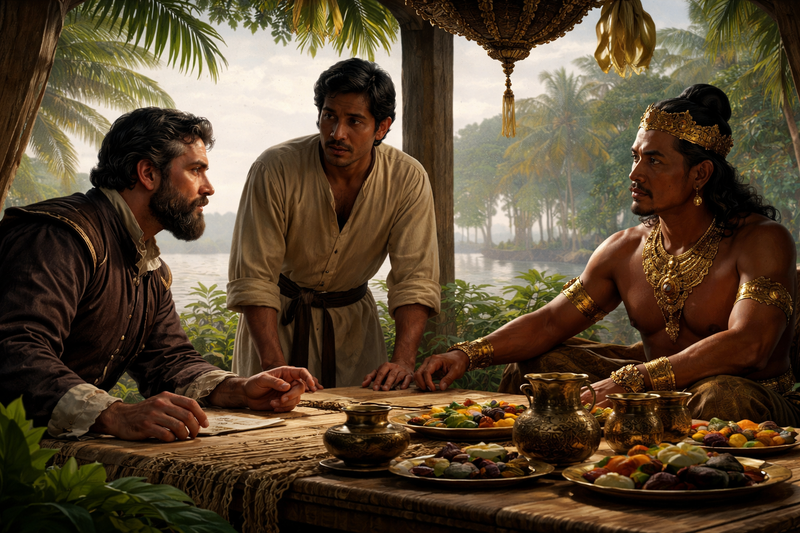
When the first meeting was arranged, it unfolded as if it had always been meant to. Mats were laid. Shade was provided. Water appeared without being asked for. The gestures were careful and complete.
Magellan read them as welcome.
He entered with composure, armor left behind, posture upright. He brought words shaped for recognition. Titles. Explanations. The logic of distant kings translated into local courtesy.
Enrique stood slightly behind and to the side, where he could hear without appearing to listen. He watched faces more than mouths. He noted where eyes lingered and where they moved away. He translated faithfully, smoothing where the weight of one language would otherwise crush another.
Humabon listened without interruption.
Listening, for Humabon, was never passive. He listened to hear what was being offered, and more importantly, what was being assumed. The foreign commander spoke as if an alliance were a natural progression, a sequence that began with courtesy and ended with obligation. Humabon understood alliance differently. Alliance was not declared. It was grown, tested through imbalance, and abandoned without ceremony if it ceased to serve.
He let Magellan speak at length because length itself was information. Men who spoke this much believed words carried authority. Sugbo’s authority rested elsewhere.
When Magellan spoke of friendship, Humabon nodded once. When Magellan spoke of alliance, Humabon asked about trade. Not directly. Not immediately. He asked instead about ships, routes, and intentions. He asked what the foreigners carried and what they lacked.
Magellan answered readily. Openness, he believed, created symmetry.
Humabon smiled.
Trade followed conversation as naturally as night followed day. Goods were shown. Prices were not named. Value moved between hands in glances and pauses. The harbor itself seemed to lean in, attentive.
Trade was Sugbo’s true language. It preceded diplomacy and outlasted it. Goods were not merely exchanged but observed, their routes traced backward in the mind. What mattered was not what the foreigners offered, but what they required in return. Ships needed water. Crews needed food. Iron and glass had novelty, but novelty did not sustain harbors.
Every exchange tightened the net slightly. Nothing closed. Nothing snapped. The foreigners were allowed to feel momentum without being allowed leverage.
Hospitality deepened. Food appeared. Not abundance, but enough. Music followed. Not celebration, but atmosphere. The foreigners were kept comfortable without being allowed to forget they were being hosted.
Magellan mistook this for progress.
Enrique did not.
He felt the shape of the imbalance even as he participated in it. Translation placed him inside the mechanism, not above it. Each sentence he rendered made the exchange smoother while also removing friction that might have slowed misunderstanding. He knew enough to recognize that hospitality here was not generosity. It was containment.
He wondered briefly whether to intervene, to clarify that delay did not mean assent, that welcome did not imply allegiance. But intervention would require authority he did not possess. He remained where he was, a hinge rather than a hand.
He saw how every offering carried a condition that did not need to be spoken. He saw how refusal never appeared as refusal. It arrived as a delay, as a redirection, as a suggestion of a better moment later.
Humabon never said no.
He said, “We will see.”
When the subject of protection arose, Humabon listened carefully. He did not ask for it. He allowed Magellan to offer. The words settled into the space between them and stayed there, undefined.
Protection implied obligation. Obligation implied hierarchy. Humabon accepted neither openly.
Instead, he widened the circle.
Other figures entered the conversation. Traders. Advisers. The babaylan, present but not foregrounded, listening more than speaking. The network revealed itself gradually, like a net drawn just tight enough to be felt.
Magellan sensed momentum and pressed.
“We stand with those who stand with us,” he said, meaning it as reassurance.
Humabon received it as information.
Enrique felt the imbalance sharpen. Alliance here was not alignment of banners. It was permission to pass, to buy, to stay without friction. Anything more would require time, leverage, and proof.
The afternoon lengthened. The tide shifted. Still, nothing was concluded.
Hospitality intensified instead.
Magellan was invited to stay. To rest. To eat again. The harbor remained open. Canoes continued to pass. Life did not rearrange itself around the foreigners.
That was the point.
Hospitality in Sugbo was never excess. It was calibration made visible. Food appeared in measured portions, sufficient to remove hunger without granting satisfaction. Shade was offered where the sun cut hardest, then withdrawn as the day shifted. Comfort was provided just long enough to establish dependence, never long enough to erase awareness of it. The foreigners were not being honored. They were being held. Every courtesy created a subtle ledger entry, not of debt, but of position. Sugbo did not trap its guests. It surrounded them gently, with rhythm and repetition, until movement itself required permission. Magellan mistook this for respect because in his world, respect flowed upward. Here, it flowed inward. To be hosted was to be placed inside another man’s design. Enrique felt the geometry tighten with each passing hour. The harbor did not close, but it narrowed. Information moved freely, but decisions did not. The foreigners were allowed to see everything except the boundaries that mattered. That was the elegance of it. Nothing was denied. Nothing was conceded. Hospitality absorbed pressure without yielding ground, turning presence into exposure. When Magellan spoke later of openness and goodwill, he did not realize that Sugbo had already defined the terms. He was welcome. He was observed. He was contained. And because no hand had closed around him, he did not yet understand that he had been grasped.
When the meeting ended, it did so without closure. Promises were not broken because none had been made. Understanding existed only where both sides needed it to.
As Magellan returned to his ship, he felt satisfaction. He had not been refused. He had not been challenged. Sugbo, in his reading, was receptive.
Enrique watched the shoreline recede and understood what had been exchanged.
Hospitality had been granted.
Power had not.
Hospitality would continue.
Alliance would wait.
That was how Sugbo ruled.
To be continued…
_________________________________________________________
Terms & Names
Terms
Barangay – A coastal settlement or community, often composed of extended kin groups.
Datu – A local chieftain whose authority rests on lineage, alliances, reputation, and force.
Babaylan – A ritual specialist, healer, and spiritual authority, often serving as intermediary between the human and spirit worlds.
Balangay – A large wooden boat used for trade, travel, and warfare across island waters.
Alipin – A dependent or bonded person; status could vary widely and was not equivalent to later colonial chattel slavery.
Sandugo – A blood compact sealing alliances or agreements between leaders.
Mangayaw – A raid or expedition, often undertaken for prestige, vengeance, or captives.
Anito – Spirits or ancestral beings believed to influence the living world.
Names & Places
Lapu-Lapu – Datu of Mangatang, a coastal leader whose authority rests on independence and control of the reefs.
Mangatang – The island later known as Mactan; a strategic settlement opposite Sugbo.
Sugbo – A powerful neighboring settlement, later known as Cebu.
Zula – A rival datu claiming influence along Mangatang’s western shore.
Hara – A woman close to Lapu-Lapu, offering counsel, grounding, and presence rather than prophecy.
Kumpar – An older warrior in Lapu-Lapu’s following, marked by experience and a direct view of power and violence.
Banog – A younger warrior, observant and efficient, often tasked with watching rather than speaking.
Bohol (Bool) – An island to the east, known in pre-colonial times as Bool.
Leyte (Tandaya) – An island to the northeast, historically referred to as Tandaya.
Olango Island – an island 5km off the east coast of Mangatang.

Comments
No comments yet. Be the first to comment!