Two Worlds Colliding · Part 5 · Protection and Its Price
When welcome becomes leverage, and refusal acquires weight

Author’s Note:
This episode turns on an old confusion: protection offered as generosity, and generosity framed as obligation. By now, land is no longer a revelation. The ships have already touched shore, already taken in water, already learned the basic grammar of these islands. What changes here is not geography, but consequence. Sugbo is the first place that answers back with power. What looks like peace begins to acquire a price.
THE SEA HAD LOST ITS NOVELTY.
They had already stepped onto island sand, already tasted fresh water that did not come from barrels, already watched ritual and curiosity play themselves out on smaller shores. The crossing was no longer the story. What remained was direction.
Now the water carried different signs.
Birds flew with confidence rather than hunger. Debris drifted not as an accident but as a message. Boats appeared not to observe, but to measure. This was not land waiting to be found. It was land that already knew itself.
On the foreign ships, the mood had improved dramatically.
Men spoke less of survival and more of position. Magellan appeared on deck before the bell, arms folded, gaze fixed ahead, not with the relief of a man nearing safety, but with the focus of someone approaching an accounting.
“You smell it,” he said once, not turning.
Enrique rested a hand on the rail. “I smell many things.”
“Power,” Magellan said.
“Yes,” Enrique replied, after a moment.
The first small boats did not rush them. They held distance, circling with ease, paddles cutting the water cleanly. The men aboard carried spears without display. This was not fear. It was confidence.
Enrique spoke first. He chose words shaped by markets rather than commands. He said they were travelers. He said they sought trade and water. He said their leader wished to speak with those who held authority here.
The island men listened without surprise.
They asked questions that did not assume submission. Who were these men. Where had they already been. What did they offer besides need.
Enrique answered carefully. He gestured ahead, toward a larger island where smoke rose steadily and boats crowded the shore.
Sugbo.
The name carried weight. It was not whispered like a rumor. It was spoken like a fact.
When he translated the invitation, Magellan heard confirmation. A rajah. A court. A hierarchy that could be entered, perhaps corrected.
“We will go,” Magellan said.
On Sugbo, preparation had already begun.
Humabon rose early and walked the edge of the water while the town woke behind him. Boats moved constantly. Traders shouted. Smoke rose thick with roasted meat. Sugbo was not a place surprised by strangers. It was a place that specialized in receiving them.
He liked that sound. Power, he knew, announced itself through ease.
His advisers gathered quickly. They spoke of iron, of thunder weapons, of babaylan. Of men who arrived with stories about gods and kings.
“And what do they want,” Humabon asked.
“Food. Water. Trade,” one adviser said. “And recognition.”
Humabon smiled faintly. “Then they want what all men want.”
He ordered gifts prepared. Gold ornaments. Fine cloth. Food in deliberate excess. He ordered the beach arranged to suggest readiness rather than defense. Spears upright, not raised. Drums slow, measured.
Welcome, when staged correctly, could obligate without appearing to demand.
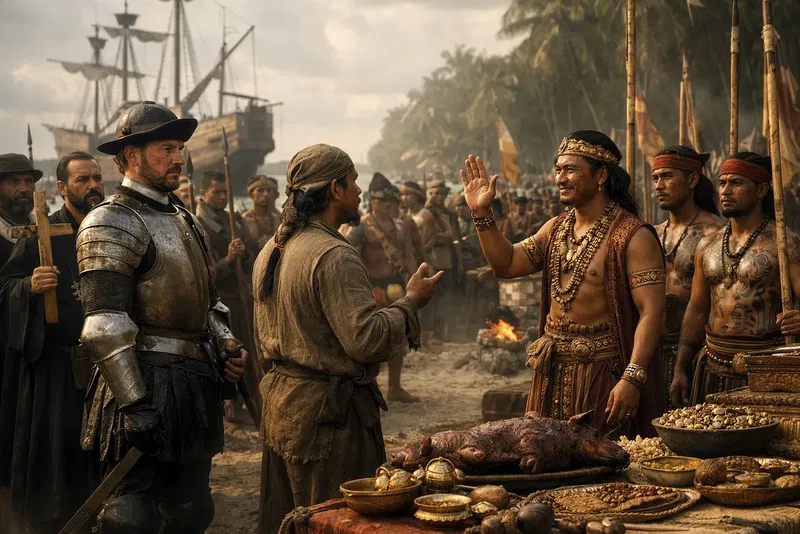
When the foreigners came ashore, Humabon stepped forward first. Palms open. Posture relaxed. He watched Magellan, the Captain-General, step onto the sand as if already assessing its value.
Enrique made the introductions.
Magellan spoke at length. He spoke of friendship. Of protection. Of a god who watched those who aligned themselves properly. His certainty arrived polished, practiced.
Humabon listened with interest.
Protection, he knew, always arrived framed as generosity. And generosity, once accepted publicly, became debt.
He replied with warmth. He spoke of unity among islands. Of peace. Of mutual benefit. He invited the foreigners to his hall.
The feast that followed was lavish enough to make restraint look rude. Humabon laughed easily. He offered food with his own hands. He watched the foreigners’ eyes linger on gold, on woven cloth, on women who did not avert their gaze.
He also watched their babaylan, their priest.
The man held a small cross as if it were both shield and blade. He spoke often to the Captain-General, quietly, insistently.
Humabon leaned toward one of his advisers. “What does that one want.”
“My lord,” the adviser said, “your obedience.”
Humabon’s smile did not change. “Then he wants what they all want.”
Across the channel, on Mangatang, word arrived without ceremony.
A fisherman spoke of ships that moved like floating houses. Of Sugbo dressed as a celebration. Of Humabon smiling like a man who believed the sea favored him.
Lapu-Lapu listened in silence.
He stood near the mangroves where roots gripped the earth and watched the channel shift with the tide. Narrow enough to cross. Wide enough to pretend separation.
“They will send for you,” Mayumi said.
“Yes,” he replied.
“And some will say you should go,” she added. “They will call it wisdom.”
“Wisdom without spine is surrender,” Lapu-Lapu said.
That evening, the message came.
A boat approached but did not land. The messenger called across the water, his voice trained for public memory.
Rajah Humabon invites you to Sugbo. To meet the Captain-General. To secure peace.
Lapu-Lapu stepped to the shoreline.
“Tell Humabon,” he said, “that peace does not require a journey.”
The boat lingered, then turned back.
On Sugbo, the refusal was received politely.
“He asserts himself,” Humabon said.
“He defies you,” Magellan replied.
“Defiance can be useful,” Humabon said. “If managed.”
Magellan spoke of complications. Of matters that required resolution. He spoke of action.
Humabon nodded, already calculating how much pressure could be applied before resistance hardened beyond use.
“Let us offer grace first,” Humabon said. “Publicly.”
Grace was another word men used for leverage.
The next invitation was larger. Louder. Cloth bearing Sugbo’s symbols. A cross raised high. The message carried across the water with practiced clarity.
No submission. No tribute. Only words.
Neutral ground, everyone knew, was a story told by those who already controlled the terms.
Lapu-Lapu answered from the shore.
“I do not meet strangers who arrive with soldiers and babaylan and call it neutrality.”
That night, a trading hut on Mangatang burned.
Not fully. Just enough. Smoke rose into the dark. Ash drifted across the village. The fire was precise, deliberate.
The owner stood shaking, face streaked with soot.
“They told me to light it,” he said. “They said it would show I understood.”
“And what do you think,” Lapu-Lapu asked.
“They will not stop,” the man whispered.
“No,” Lapu-Lapu said. “They will not.”
By morning, uncertainty had thinned into anger.
Lapu-Lapu stood before the gathered village.
“They offer protection,” he said. “But protection that demands obedience is only another kind of threat.”
Faces hardened.
“We will not cross the channel,” he continued. “We will not strike first. But we will no longer pretend this is only talk.”
The babaylan stepped forward, voice calm, carrying.
“The tide has turned,” she said. “Those who stand together will stand longer.”
Across the channel, watch fires appeared along Mangatang’s shore, spaced deliberately.
“They are preparing,” Magellan said.
“Yes,” Enrique replied.
“Then so will we.”
Enrique looked at the water between the islands. At how narrow it seemed now. How quickly welcome had turned into accounting.
On Mangatang, Lapu-Lapu walked the shoreline alone before dawn, listening to the water lap against the roots, feeling the pull beneath his feet.
The price of welcome had been named.
No one had yet agreed to pay it.
To be continued…
_______________________________________________________
Terms & Names
Terms
Barangay – A coastal settlement or community, often composed of extended kin groups.
Datu – A local chieftain whose authority rests on lineage, alliances, reputation, and force.
Babaylan – A ritual specialist, healer, and spiritual authority, often serving as intermediary between the human and spirit worlds.
Balangay – A large wooden boat used for trade, travel, and warfare across island waters.
Alipin – A dependent or bonded person; status could vary widely and was not equivalent to later colonial chattel slavery.
Sandugo – A blood compact sealing alliances or agreements between leaders.
Mangayaw – A raid or expedition, often undertaken for prestige, vengeance, or captives.
Anito – Spirits or ancestral beings believed to influence the living world.
Names & Places
Lapu-Lapu – Datu of Mangatang, a coastal leader whose authority rests on independence and control of the reefs.
Mangatang – The island later known as Mactan; a strategic settlement opposite Sugbo.
Sugbo – A powerful neighboring settlement, later known as Cebu.
Zula – A rival datu claiming influence along Mangatang’s western shore.
Hara – A woman close to Lapu-Lapu, offering counsel, grounding, and presence rather than prophecy.
Kumpar – An older warrior in Lapu-Lapu’s following, marked by experience and a direct view of power and violence.
Banog – A younger warrior, observant and efficient, often tasked with watching rather than speaking.
Bohol (Bool) – An island to the east, known in pre-colonial times as Bool.
Leyte (Tandaya) – An island to the northeast, historically referred to as Tandaya.
Olango Island – an island 5km off the east coast of Mangatang.
Comments
No comments yet. Be the first to comment!