Beyond Monogamy and Myth
What Human Sexuality Really Reveals About Who We Are

Author’s Introduction: Why This Question Refuses to Go Away
Few subjects sit as uncomfortably at the intersection of biology, culture, morality, and identity as sexuality. It is where instinct meets narrative, where private desire collides with public expectation. We are told, often with great certainty, what is “natural,” what is “healthy,” what is “normal.” And yet, for something supposedly so settled, human sexuality generates an extraordinary amount of confusion, guilt, secrecy, and quiet dissatisfaction.
For many people, this tension is most visible in relation to monogamy. Despite being held up as the gold standard for intimacy and commitment, monogamy is also the relational structure that most reliably produces anxiety around desire, fear of infidelity, and a sense of personal failure when attraction wanders. This contradiction is so common that it is rarely questioned. Instead, individuals internalize the struggle, assuming the problem lies in their willpower, their maturity, or their moral fiber.
It was precisely this quiet, widespread dissonance that made Sex at Dawn such a disruptive work when it appeared. Written by Christopher Ryan and Cacilda Jethá, the book challenged one of modern society’s most deeply ingrained assumptions: that lifelong sexual exclusivity is humanity’s natural default, and that deviation from it represents a biological or moral failing.
What made the book resonate was not merely its boldness, but its timing. It arrived at a moment when traditional relationship models were already under strain, when divorce rates, infidelity statistics, and the rise of alternative relationship structures suggested that something in the prevailing story was incomplete. Sex at Dawn did not create these questions. It gave them a voice many people already recognized as their own.
This essay is not an endorsement of any particular relational model. It is an attempt to synthesize what Sex at Dawn contributed, what subsequent research has clarified or corrected, and what a more integrated understanding of human sexuality now looks like. The goal is neither rebellion nor nostalgia, but coherence. To understand where our sexual instincts come from, how culture reshaped them, and what that means for intimacy in the modern world.
The Core Claim: Sexuality Before Agriculture
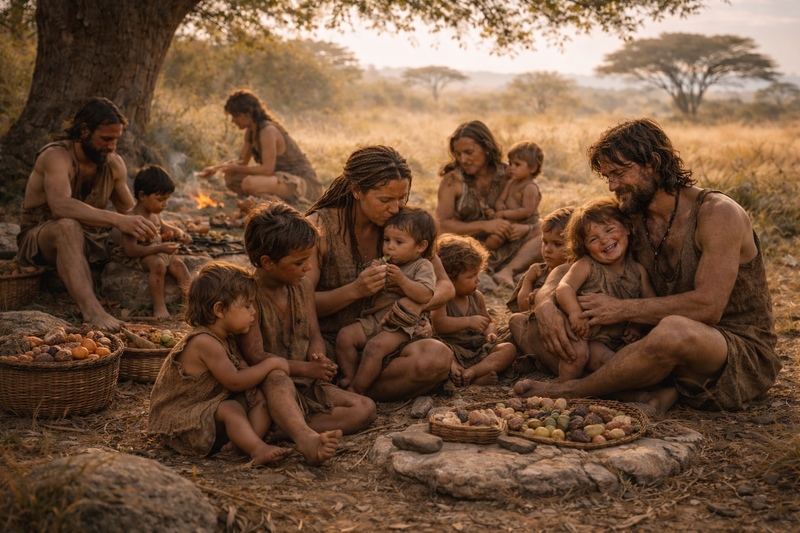
At the heart of Sex at Dawn lies a simple but unsettling proposition: for most of human evolutionary history, sexual exclusivity was not the organizing principle of intimate life. Instead, Ryan and Jethá argue, our ancestors lived in small, egalitarian hunter-gatherer bands where sexual relationships were relatively fluid, communal bonds were strong, and rigid notions of ownership over partners had little relevance.
This claim stands in direct opposition to the authors’ “standard narrative” of evolutionary psychology. According to that narrative, men evolved to seek multiple partners in order to spread their genes, while women evolved to seek reliable providers to ensure offspring survival. Monogamy, in this view, emerges naturally from female selectivity and male provisioning.
Ryan and Jethá argue that this framework projects modern, property-based social arrangements backward onto a prehistoric world that did not share them. For hundreds of thousands of years, humans lived without accumulated wealth, without inheritance in the modern sense, and without centralized authority. In such conditions, controlling sexual access would have served little purpose, and enforcing it would have been nearly impossible.
Instead, the authors propose a model in which sexuality functioned primarily as a social glue. Sexual reinforcement of alliances, tension reduction, and strengthened group cohesion. Paternity was often ambiguous, which reduced male competition and encouraged cooperative child-rearing. Rather than destabilizing communities, sexual openness helped stabilize them.
This is not presented as a utopia, but as a functional adaptation to a specific ecological and social environment. Human sexuality, in this view, evolved not around ownership and exclusivity, but around connection and resilience.
Biology as Clue, Not Command
One of the most provocative aspects of Sex at Dawn is its use of biological evidence to support its claims. The authors point to several anatomical and behavioral traits that are difficult to reconcile with strict monogamy as an evolutionary baseline.
Human males have testicular sizes intermediate between those of species that are strictly monogamous and those characterized by intense sperm competition. This suggests a mating system in which females historically had access to multiple partners within a relatively short time frame. Similarly, the shape of the human penis appears adapted to displace semen, another trait associated with sperm competition.
Female sexuality also complicates the monogamy narrative. Human females exhibit concealed ovulation, extended sexual receptivity, and sexual behaviors that are not tightly linked to reproduction. Desire does not peak exclusively during fertile windows, and sexual expression often appears motivated by bonding and pleasure rather than conception.
Ryan and Jethá also discuss female copulatory vocalizations, which, in some species, function to attract additional mates or to signal sexual availability beyond a single partner. While human sexuality is far more complex than any primate comparison, these features raise legitimate questions about whether exclusive pair bonding was ever the primary evolutionary strategy.
Importantly, biology here is not destiny. These traits do not dictate how humans must behave; they only specify the kinds of behaviors our nervous systems can support without strain. Culture determines which possibilities are encouraged, constrained, or moralized.
Bonobos, Chimpanzees, and the Stories We Choose
A central metaphor in Sex at Dawn contrasts two of our closest primate relatives: chimpanzees and bonobos. Chimpanzees live in hierarchical, male-dominated groups marked by aggression, territorial violence, and coercive mating. Bonobos, by contrast, are more egalitarian, less violent, and famously sexual. They use sex to resolve conflict, reinforce alliances, and maintain social harmony.
Traditional evolutionary narratives tend to emphasize chimpanzees as the more “natural” model for human behavior, particularly male competition and female choosiness. Ryan and Jethá argue that this preference reflects modern cultural assumptions more than evolutionary reality. Bonobos are as closely related to humans and, in many social dimensions, more similar.
The point is not that humans are bonobos, but that we selectively choose analogies that reinforce existing beliefs. When sexuality is framed primarily as competition and conquest, exclusivity appears necessary to impose order. When it is framed as bonding and communication, a wider range of relational possibilities becomes visible.
Subsequent scholarship has been more cautious in drawing direct parallels, but the broader insight remains valuable: human sexuality is flexible, context-dependent, and deeply shaped by social structures.
From Sharing to Owning: Agriculture’s Quiet Revolution
Where Sex at Dawn is most persuasive is in tracing the shift from foraging societies to agricultural ones. The domestication of plants and animals fundamentally altered human social organization. Land became valuable. Resources could be stored. Wealth could be accumulated and inherited.
With this shift came a new anxiety: lineage. Knowing who one’s offspring were and ensuring that property passed through “legitimate” heirs became essential. In this context, controlling female sexuality took on enormous social importance. Monogamy, chastity, and patriarchal authority emerged not as timeless virtues but as solutions to new economic problems.
This does not mean that monogamy was imposed cynically or universally. Cultural evolution is rarely deliberate. Practices that support stability tend to persist, especially when reinforced by religion, law, and moral narratives. Over time, these practices come to feel natural, even inevitable.
The cost of this stability, however, is often borne internally. Desire becomes suspect. Jealousy is normalized. Sexual variation is framed as deviance rather than diversity. What was once managed socially becomes moralized at the individual level.
What Later Research Has Clarified
Since the publication of Sex at Dawn, many scholars have revisited its claims. Critics have rightly pointed out that hunter-gatherer societies are diverse, and that many do exhibit forms of pair bonding and sexual exclusivity. There was no single prehistoric sexual arrangement, just as there is no single modern one.
Anthropologists such as Justin R. Garcia have emphasized that human sexuality evolved to support both long-term bonds and extra-pair attractions. Pair bonding likely offered advantages in child-rearing and resource sharing, while sexual openness supported alliance-building and genetic diversity.
Others, including Peter B. Gray, have criticized Sex at Dawn for overstating the prevalence of sexual egalitarianism and underplaying the role of attachment. These critiques are important. They move the conversation away from binaries and toward nuance.
What emerges from the broader body of research is not a refutation, but a refinement. Humans appear to be naturally pluralistic in their sexual capacities. We are capable of deep attachment and enduring bonds, and we are capable of desire that extends beyond them. Trouble arises not from either impulse but from pretending only one exists.
Jealousy, Attachment, and the Nervous System
One of the most emotionally charged objections to non-exclusive models is jealousy. It is often treated as evidence that monogamy is natural and that alternatives are psychologically unrealistic. Yet contemporary psychology paints a more complex picture.
Jealousy is not a single instinct. It is a composite emotional response involving fear of loss, comparison, insecurity, and attachment threat. These responses are heavily influenced by early bonding experiences, cultural narratives, and perceived scarcity.
Attachment theory suggests that humans are wired for connection, not possession. Secure attachment allows individuals to tolerate ambiguity and change without catastrophic anxiety. Insecure attachment amplifies threats and seeks control as a form of self-protection.
From this perspective, jealousy is not proof of monogamy’s inevitability, but evidence of how deeply relational safety matters. Monogamy can provide that safety for many people. So can other arrangements, when built on trust, communication, and realistic expectations.
Desire, Novelty, and the Long-Term Bond
Modern neuroscience has further clarified why desire and long-term partnership often feel at odds. The neurochemical systems underlying romantic attachment, mediated by oxytocin and vasopressin, are distinct from those underlying sexual novelty, which is mediated largely by dopamine.
This does not mean that long-term relationships are incompatible with desire, but it does mean they require intentional cultivation. Expecting passion to remain spontaneous and effortless over decades is biologically unrealistic, regardless of relationship structure.
Here, Sex at Dawn offers a valuable reframing. The decline of sexual novelty in long-term partnerships is not necessarily a sign of failure. It is a predictable outcome of the brain’s prioritization of stability over excitement. Recognizing this allows couples to address desire consciously, rather than interpreting fluctuations in desire as betrayal or inadequacy.
Sexuality Without Moral Panic
Perhaps the most enduring contribution of Sex at Dawn is not its anthropology, but its tone. It treats sexuality as something to be understood, not disciplined. It refuses to frame desire as a problem requiring control.
This approach aligns with contemporary sex research, which increasingly emphasizes consent, communication, and psychological well-being over rigid moral frameworks. Ethical non-monogamy, for example, is now studied not as deviance, but as a legitimate relational orientation with its own challenges and strengths.
At the same time, monogamy remains a deeply meaningful and fulfilling choice for many. The point is not to replace one orthodoxy with another, but to allow choice to be conscious rather than inherited.
Relevance for Today’s Society
We live in a moment of unprecedented relational experimentation. Dating apps expose users to more potential partners than any previous generation. Gender roles are in flux. Traditional institutions no longer dictate life paths with the authority they once held.
In this environment, clinging to simplified stories about sexuality does more harm than good. People need frameworks that acknowledge complexity, ambivalence, and change. They need permission to want what they want without shame, and guidance on how to navigate desire ethically.
Sex at Dawn remains relevant not because it provides definitive answers, but because it loosens the grip of inevitability. It reminds us that many of the rules we treat as natural laws are, in fact, cultural agreements. And agreements can be examined, revised, or reaffirmed with intention.
A Mindful Closing Reflection
Understanding human sexuality does not require choosing sides. It requires humility. The humility to admit that our instincts are older than our institutions, and that our institutions are often younger than our confidence in them.
Monogamy can be chosen consciously as a meaningful commitment rather than a default expectation. Non-monogamy can be explored ethically, without romanticizing or denying its difficulties. Celibacy, fluidity, and every variation in between can be understood as responses to real human needs rather than deviations from the norm.
What matters most is not which structure we adopt, but whether it allows for honesty, care, and psychological safety. When sexuality is approached with curiosity instead of fear, it becomes less of a battleground and more of a mirror. One that reflects not just how we love, but how we understand ourselves.
In that sense, the real provocation of Sex at Dawn is not sexual openness. It is the invitation to stop outsourcing our most intimate questions to tradition, and to begin answering them with awareness.

Comments
No comments yet. Be the first to comment!