Two Worlds Colliding · Part 1 · The Shore Before Names
Before the world learned how to say his name

Author’s Notes:
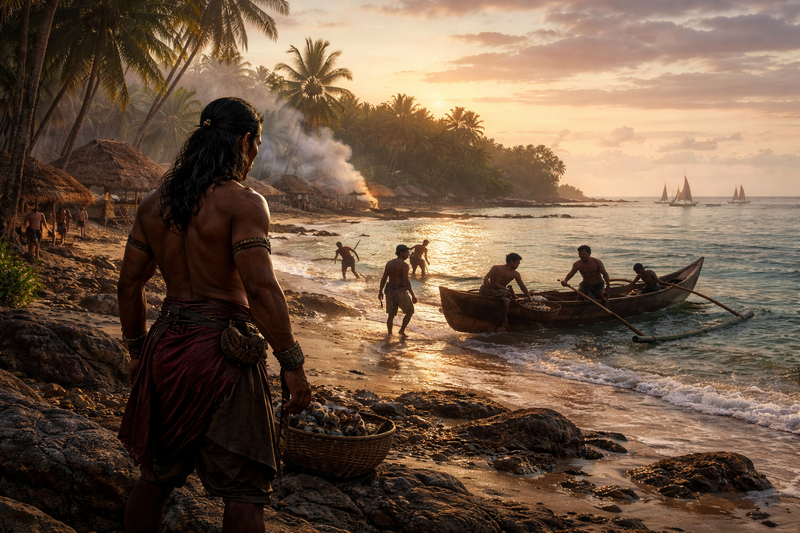
Before ships carried flags and crosses, before maps pinned names onto water and shore, there were places that answered only to tide, reef, and memory.
The island of Mactan, or as it was called back then, Mangatang, was one of them. Positioned opposite Sugbo, present-day Cebu, is where this story begins.
Here, power did not announce itself. It revealed itself slowly, through silence held at the right moment, through decisions made before others realized a choice existed. This is not the beginning of a battle. It is the beginning of pressure, felt first by those who know how to listen.
_________________________________________________________
The sea had moods the way men did.
At dawn it lay flat and bright as hammered tin, as if it had never known rage. By midmorning, it breathed, lifting itself in slow swells that nudged the outriggers and made the boys curse softly as they steadied the baskets of shellfish. At night, it could become a throat that swallowed light. You could live your whole life on its edge and still wake sometimes with your heart running, convinced you had heard it calling your name.
Lapu-Lapu stood where broken coral gave way to rubble and then to sand, the first palms leaning toward the water, watching the tide drain from the shallows. The reef showed its bones. Patches of black rock broke the surface like knuckles. The channels, the safe ones, marked themselves in darker ribbons where the water ran deeper, where a boat could slide through without tearing its belly open.
He knew those channels the way he knew his own scars. Not all at once, but by the memory of pain and survival layered over time.
Behind him, the barangay stirred. Smoke climbed from cook fires in thin, patient columns. Dogs moved among the huts like thieves, noses down, tails flicking, hoping for a drop of broth or a strip of fish skin. Children chased one another through the posts of raised houses, their laughter sharp and sudden, like birds flinging themselves into the air. A woman called after them, not sharply enough to stop them, only to remind them she existed.
Men were already awake, the ones worth anything. The ones who rose without being summoned. The others woke later, when their women kicked them, or when hunger made them move. A man’s usefulness showed early in the day.
A canoe came in low and fast through the channel, its outrigger slapping the swell. Two men paddled; a third crouched in the bow with a spear laid across his thighs, as if he expected the sea itself to rise and fight him. The canoe grounded on the sand with a scrape that carried farther than it should have.
Lapu-Lapu did not move to greet them.
A leader who ran to every arrival taught people that his time was cheap. A leader who waited made others step into his orbit, his gravity.
The bowman climbed out first, water up to his knees, and dragged the canoe higher. He was young, broad-shouldered, still carrying the eagerness of men who had not yet learned that the world did not reward it. One of the paddlers lifted a woven bag from the hull and held it with both hands, not above his head, not hidden. An offering presented properly.
The older paddler stepped forward, eyes lowered, and stopped at the edge of the coral rubble where Lapu-Lapu’s shadow fell.
“Datu,” the man said, the word weighted, deliberate.
Lapu-Lapu let silence stretch. He watched the man’s hands. Rough, salt-cracked, strong. Not a court man’s hands. Not a man who lived by speech alone. A man who could be trusted to hold a paddle through a storm, or a blade through blood.
“What brings you at this hour?” Lapu-Lapu asked.
“News from the north channel,” the paddler said. “And fish, before the sun warms it.”
He set the bag down and untied it. The smell rose immediately. Fresh mackerel, silver and slick, their eyes still clear. A good gift. Not a bribe. A sign of respect and urgency in equal measure.
Lapu-Lapu nodded once, accepting the fish without reaching for it.
“Speak.”
“Ships passed yesterday,” the man said. “Three of them. Not from our side. Not from Sugbo. Too large for the traders we know. Their sails were high and white, like the belly of a fish.”
Lapu-Lapu kept his gaze on the sea, but something tightened behind his eyes. Large boats existed. Boats that carried men who did not belong to the rhythms of reefs and tides. People liked to speak of the wide world as if it were a children’s story, but the world was real. Wind did not stop at the edge of Mangatang.
“And?” he said.
“There was smoke this morning,” the paddler continued. “From the western mangroves. Thick. A fire meant to be seen.”
Lapu-Lapu turned his head at last.
Smoke was never accidental.
“Who watches that shore?” he asked.
“Two of your men. Three of mine.”
“Bring me one,” Lapu-Lapu said. “Now.”
Relief flickered across the paddler’s face. He had delivered his burden. The weight moved elsewhere.
When the canoe pushed off again, Lapu-Lapu remained where he was, watching the paddles bite water, watching the men angle into the channel only those raised here could see.
A leader did not fear news. He feared the day no one brought it.
Footsteps crunched behind him over coral rubble. Heavy. Unhurried. Lapu-Lapu did not turn. He knew the sound of each man under his roof.
Kumpar came to his side, hair bound back, tattooed chest scored with pale lines that marked old fights and older survivals. He smelled of smoke and old sweat.
“You heard,” Kumpar said.
“I heard.”
“Smoke from the mangroves is Zula,” Kumpar said. “He wants you to come.”
“He wants me to respond,” Lapu-Lapu replied. “That is not the same thing.”
“If he gathers men, he will boast you did nothing.”
Lapu-Lapu’s mouth curved slightly, without humor. “If I run to every boast, I become his dog. Let him do the barking.”
He sent watchers west. Not to fight. To see.
Then he turned back toward the barangay. Blades were being sharpened. The scrape of stone on metal was intimate, almost private. Men paused as he passed, reading his posture, the set of his shoulders. They would know by noon whether there was to be blood.
Inside his house, the air was cooler.
A woman lay on the mat, unhidden, unafraid. She turned her head when he entered, as if the space itself had shifted.
She did not ask where he had been.
That question belonged to people who feared answers.
They lay together without ceremony. Not escape. Not indulgence. Continuation. Outside, the island moved on, indifferent to what it was becoming.
Later, she traced idle lines across his skin.
“You are being measured,” she said.
“I always am.”
“Not like this.”
She rose and untied a small bundle from a peg, handing him a dark woven cord.
“For your wrist.”
“A charm?”
“A reminder,” she said. “When you speak, remember what you want. Not what they want to pull from you.”
He tied it on. The cord bit his skin slightly. Useful pain.
“You should eat,” she said. “And you will go to the babaylan.”
He did not like being predicted.
“Yes,” he said.
She left. The house settled into its own shape.
Outside, the barangay breathed on. The noise of it had changed. Not louder. Sharper.
The shore still had no names the world would remember. But it was already being weighed.
—
Smoke had drawn the first line. Words would draw the next.
Before the day was done, Lapu-Lapu would step into a circle where silence listened back, and where the future did not ask permission before speaking.
To be continued….
__________________________________________________________
Terms
Alipin – A dependent or bonded person; status varied and was not equivalent to later colonial chattel slavery.
Anito – Spirits or ancestral beings believed to influence the living world.
Babaylan – A ritual specialist, healer, and spiritual authority.
Bahay kubo – A traditional stilted dwelling made of wood and bamboo, with steeply pitched nipa-leaf roofing and extended eaves.
Balangay – A large wooden boat used for trade, travel, and warfare.
Barangay – A coastal settlement or community.
Datu – A local chieftain whose authority rests on lineage and power.
Mangayaw – A raid or expedition undertaken for prestige or captives.
Sandugo – A blood compact used to seal alliances or agreements.
Names & Places
Bohol (Bool) – An island to the east, known in pre-colonial times as Bool.
Cartagena – A foreign figure whose presence signals expanding outside influence.
Hara – A woman close to Lapu-Lapu, offering counsel and grounding.
Kumpar – An older warrior in Lapu-Lapu’s following.
Lapu-Lapu – Datu of Mangatang, known for his independence.
Leyte (Tandaya) – An island historically referred to as Tandaya.
Mangatang – The island later known as Mactan.
Mayumi – A woman whose relationships affect alliances and tensions.
Si Gama – A foreign captain known first through rumor and report.
Sugbo – A powerful neighboring settlement, present-day Cebu.
Zula – A rival datu claiming influence along Mangatang’s western shore.
Sandugo – A blood compact used to seal alliances or agreements.
Mangayaw – A raid or expedition undertaken for prestige, vengeance, or captives.
Anito – Spirits or ancestral beings believed to influence the living world.
Comments
No comments yet. Be the first to comment!