
-
Beyond Monogamy and Myth
fev 08 ⎯ Não traduzidoAuthor’s Introduction: Why This Question Refuses to Go Away Few subjects sit as uncomfortably at the intersection of biology, culture, morality, and identity as sexuality. It is where instinct meets narrative, where private desire collides with public expectation. We are told, often with great certainty, what is “natural,” what is “healthy,” what is “normal.” And yet, for something supposedly so settled, human sexuality generates an extraordinary amount of confusion, guilt, secrecy, and quiet dissatisfaction. For many people, this tension is most visible in relation to monogamy. Despite being held up as the gold standard for intimacy and commitment, monogamy is also the relational structure that most reliably produces anxiety around desire, fear of infidelity, and a sense of personal failure when attraction wanders. This contradiction is so common that it is rarely questioned. Instead, individuals internalize the struggle, assuming the problem lies in their willpower, their maturity, or their moral fiber. It was precisely this quiet, widespread dissonance that made Sex at Dawn such a disruptive work when it appeared. Written by Christopher Ryan and Cacilda Jethá, the book challenged one of modern society’s most deeply ingrained assumptions: that lifelong sexual exclusivity is humanity’s natural default, and that deviation from it represents a biological or moral failing. What made the book resonate was not merely its boldness, but its timing. It arrived at a moment when traditional relationship models were already under strain, when divorce rates, infidelity statistics, and the rise of alternative relationship structures suggested that something in the prevailing story was incomplete. Sex at Dawn did not create these questions. It gave them a voice many people already recognized as their own. This essay is not an endorsement of any particular relational model. It is an attempt to synthesize what Sex at Dawn contributed, what subsequent research has clarified or corrected, and what a more integrated understanding of human sexuality now looks like. The goal is neither rebellion nor nostalgia, but coherence. To understand where our sexual instincts come from, how culture reshaped them, and what that means for intimacy in the modern world. The Core Claim: Sexuality Before Agriculture At the heart of Sex at Dawn lies a simple but unsettling proposition: for most of human evolutionary history, sexual exclusivity was not the organizing principle of intimate life. Instead, Ryan and Jethá argue, our ancestors lived in small, egalitarian hunter-gatherer bands where sexual relationships were relatively fluid, communal bonds were strong, and rigid notions of ownership over partners had little relevance. This claim stands in direct opposition to the authors’ “standard narrative” of evolutionary psychology. According to that narrative, men evolved to seek multiple partners in order to spread their genes, while women evolved to seek reliable providers to ensure offspring survival. Monogamy, in this view, emerges naturally from female selectivity and male provisioning. Ryan and Jethá argue that this framework projects modern, property-based social arrangements backward onto a prehistoric world that did not share them. For hundreds of thousands of years, humans lived without accumulated wealth, without inheritance in the modern sense, and without centralized authority. In such conditions, controlling sexual access would have served little purpose, and enforcing it would have been nearly impossible. Instead, the authors propose a model in which sexuality functioned primarily as a social glue. Sexual reinforcement of alliances, tension reduction, and strengthened group cohesion. Paternity was often ambiguous, which reduced male competition and encouraged cooperative child-rearing. Rather than destabilizing communities, sexual openness helped stabilize them. This is not presented as a utopia, but as a functional adaptation to a specific ecological and social environment. Human sexuality, in this view, evolved not around ownership and exclusivity, but around connection and resilience. Biology as Clue, Not Command One of the most provocative aspects of Sex at Dawn is its use of biological evidence to support its claims. The authors point to several anatomical and behavioral traits that are difficult to reconcile with strict monogamy as an evolutionary baseline. Human males have testicular sizes intermediate between those of species that are strictly monogamous and those characterized by intense sperm competition. This suggests a mating system in which females historically had access to multiple partners within a relatively short time frame. Similarly, the shape of the human penis appears adapted to displace semen, another trait associated with sperm competition. Female sexuality also complicates the monogamy narrative. Human females exhibit concealed ovulation, extended sexual receptivity, and sexual behaviors that are not tightly linked to reproduction. Desire does not peak exclusively during fertile windows, and sexual expression often appears motivated by bonding and pleasure rather than conception. Ryan and Jethá also discuss female copulatory vocalizations, which, in some species, function to attract additional mates or to signal sexual availability beyond a single partner. While human sexuality is far more complex than any primate comparison, these features raise legitimate questions about whether exclusive pair bonding was ever the primary evolutionary strategy. Importantly, biology here is not destiny. These traits do not dictate how humans must behave; they only specify the kinds of behaviors our nervous systems can support without strain. Culture determines which possibilities are encouraged, constrained, or moralized. Bonobos, Chimpanzees, and the Stories We Choose A central metaphor in Sex at Dawn contrasts two of our closest primate relatives: chimpanzees and bonobos. Chimpanzees live in hierarchical, male-dominated groups marked by aggression, territorial violence, and coercive mating. Bonobos, by contrast, are more egalitarian, less violent, and famously sexual. They use sex to resolve conflict, reinforce alliances, and maintain social harmony. Traditional evolutionary narratives tend to emphasize chimpanzees as the more “natural” model for human behavior, particularly male competition and female choosiness. Ryan and Jethá argue that this preference reflects modern cultural assumptions more than evolutionary reality. Bonobos are as closely related to humans and, in many social dimensions, more similar. The point is not that humans are bonobos, but that we selectively choose analogies that reinforce existing beliefs. When sexuality is framed primarily as competition and conquest, exclusivity appears necessary to impose order. When it is framed as bonding and communication, a wider range of relational possibilities becomes visible. Subsequent scholarship has been more cautious in drawing direct parallels, but the broader insight remains valuable: human sexuality is flexible, context-dependent, and deeply shaped by social structures. From Sharing to Owning: Agriculture’s Quiet Revolution Where Sex at Dawn is most persuasive is in tracing the shift from foraging societies to agricultural ones. The domestication of plants and animals fundamentally altered human social organization. Land became valuable. Resources could be stored. Wealth could be accumulated and inherited. With this shift came a new anxiety: lineage. Knowing who one’s offspring were and ensuring that property passed through “legitimate” heirs became essential. In this context, controlling female sexuality took on enormous social importance. Monogamy, chastity, and patriarchal authority emerged not as timeless virtues but as solutions to new economic problems. This does not mean that monogamy was imposed cynically or universally. Cultural evolution is rarely deliberate. Practices that support stability tend to persist, especially when reinforced by religion, law, and moral narratives. Over time, these practices come to feel natural, even inevitable. The cost of this stability, however, is often borne internally. Desire becomes suspect. Jealousy is normalized. Sexual variation is framed as deviance rather than diversity. What was once managed socially becomes moralized at the individual level. What Later Research Has Clarified Since the publication of Sex at Dawn, many scholars have revisited its claims. Critics have rightly pointed out that hunter-gatherer societies are diverse, and that many do exhibit forms of pair bonding and sexual exclusivity. There was no single prehistoric sexual arrangement, just as there is no single modern one. Anthropologists such as Justin R. Garcia have emphasized that human sexuality evolved to support both long-term bonds and extra-pair attractions. Pair bonding likely offered advantages in child-rearing and resource sharing, while sexual openness supported alliance-building and genetic diversity. Others, including Peter B. Gray, have criticized Sex at Dawn for overstating the prevalence of sexual egalitarianism and underplaying the role of attachment. These critiques are important. They move the conversation away from binaries and toward nuance. What emerges from the broader body of research is not a refutation, but a refinement. Humans appear to be naturally pluralistic in their sexual capacities. We are capable of deep attachment and enduring bonds, and we are capable of desire that extends beyond them. Trouble arises not from either impulse but from pretending only one exists. Jealousy, Attachment, and the Nervous System One of the most emotionally charged objections to non-exclusive models is jealousy. It is often treated as evidence that monogamy is natural and that alternatives are psychologically unrealistic. Yet contemporary psychology paints a more complex picture. Jealousy is not a single instinct. It is a composite emotional response involving fear of loss, comparison, insecurity, and attachment threat. These responses are heavily influenced by early bonding experiences, cultural narratives, and perceived scarcity. Attachment theory suggests that humans are wired for connection, not possession. Secure attachment allows individuals to tolerate ambiguity and change without catastrophic anxiety. Insecure attachment amplifies threats and seeks control as a form of self-protection. From this perspective, jealousy is not proof of monogamy’s inevitability, but evidence of how deeply relational safety matters. Monogamy can provide that safety for many people. So can other arrangements, when built on trust, communication, and realistic expectations. Desire, Novelty, and the Long-Term Bond Modern neuroscience has further clarified why desire and long-term partnership often feel at odds. The neurochemical systems underlying romantic attachment, mediated by oxytocin and vasopressin, are distinct from those underlying sexual novelty, which is mediated largely by dopamine. This does not mean that long-term relationships are incompatible with desire, but it does mean they require intentional cultivation. Expecting passion to remain spontaneous and effortless over decades is biologically unrealistic, regardless of relationship structure. Here, Sex at Dawn offers a valuable reframing. The decline of sexual novelty in long-term partnerships is not necessarily a sign of failure. It is a predictable outcome of the brain’s prioritization of stability over excitement. Recognizing this allows couples to address desire consciously, rather than interpreting fluctuations in desire as betrayal or inadequacy. Sexuality Without Moral Panic Perhaps the most enduring contribution of Sex at Dawn is not its anthropology, but its tone. It treats sexuality as something to be understood, not disciplined. It refuses to frame desire as a problem requiring control. This approach aligns with contemporary sex research, which increasingly emphasizes consent, communication, and psychological well-being over rigid moral frameworks. Ethical non-monogamy, for example, is now studied not as deviance, but as a legitimate relational orientation with its own challenges and strengths. At the same time, monogamy remains a deeply meaningful and fulfilling choice for many. The point is not to replace one orthodoxy with another, but to allow choice to be conscious rather than inherited. Relevance for Today’s Society We live in a moment of unprecedented relational experimentation. Dating apps expose users to more potential partners than any previous generation. Gender roles are in flux. Traditional institutions no longer dictate life paths with the authority they once held. In this environment, clinging to simplified stories about sexuality does more harm than good. People need frameworks that acknowledge complexity, ambivalence, and change. They need permission to want what they want without shame, and guidance on how to navigate desire ethically. Sex at Dawn remains relevant not because it provides definitive answers, but because it loosens the grip of inevitability. It reminds us that many of the rules we treat as natural laws are, in fact, cultural agreements. And agreements can be examined, revised, or reaffirmed with intention. A Mindful Closing Reflection Understanding human sexuality does not require choosing sides. It requires humility. The humility to admit that our instincts are older than our institutions, and that our institutions are often younger than our confidence in them. Monogamy can be chosen consciously as a meaningful commitment rather than a default expectation. Non-monogamy can be explored ethically, without romanticizing or denying its difficulties. Celibacy, fluidity, and every variation in between can be understood as responses to real human needs rather than deviations from the norm. What matters most is not which structure we adopt, but whether it allows for honesty, care, and psychological safety. When sexuality is approached with curiosity instead of fear, it becomes less of a battleground and more of a mirror. One that reflects not just how we love, but how we understand ourselves. In that sense, the real provocation of Sex at Dawn is not sexual openness. It is the invitation to stop outsourcing our most intimate questions to tradition, and to begin answering them with awareness.
-
Two Worlds Colliding · Part 4 · Two Ways of Hearing the World
fev 04 ⎯ Não traduzidoAuthor’s Notes: This episode listens rather than moves. It sets belief beside belief and lets them fail to coincide. Words do not carry the same weight in every world. Some bind. Some observe. Some pierce. When translation assumes equivalence, meaning becomes asymmetric, and the wound opens quietly. The babaylan did not speak first. The babaylan’s authority was not announced. It accumulated. People deferred to her without performance, not because she demanded it, but because she named things that others felt and could not yet articulate. In a world where tide and weather could ruin a season in a single night, certainty was suspicious. What mattered was attunement. The babaylan listened for shifts in pattern, in appetite, in the small disturbances that preceded visible change. The arrival of the ships was not merely an event; it was a reordering of attention. She felt that attention like pressure at the base of the throat, the way animals did when storms approached. She listened. She listened to the harbor, to the pattern of movement that followed the ships’ arrival. She listened to the way men spoke more quickly when they believed themselves understood. She listened for what did not arrive. Language was never only sound. It was posture. It was timing. It was the space allowed for silence to complete a thought. When she did speak, it was not to address the foreigners directly. It was to name what their presence had altered. The water moved differently now. Attention gathered where it had not before. To her, belief was not argument. It was orientation. Belief did not need conversion to remain powerful. It did not need a single name to remain coherent. It existed as a relationship between people and sea, between the living and the dead, between hunger and restraint. The dead were not gone. They were present in the habits that survived them, in the warnings that had proven true often enough to become law. When the babaylan spoke, she did not persuade. She aligned. She shifted the room’s posture. She reminded people what had always been there and what was arriving disguised as novelty. That was why foreign certainty felt wrong to her. It tried to replace orientation with instruction, as if the world were a thing to be corrected rather than listened to. Across the harbor, Magellan relied on words shaped to compel agreement. Magellan’s language carried a different purpose. It was built for hierarchy. It was named, then demanded that the name be accepted. It assumed that clarity was virtue, that a single truth, spoken cleanly, reduced conflict. In his world, ambiguity created weakness. On a ship, ambiguity killed. Orders had to land immediately, in identical form, in every ear. He brought that discipline ashore and expected it to operate there as well. He did not understand that on land, and especially in a harbor that survived by negotiation, ambiguity was not failure. It was flexibility. It was a space where power could maneuver without drawing blood. He believed language could make the unfamiliar legible. That explanation preceded compliance. When he spoke of faith, he did so carefully, confident that clarity would travel. The babaylan heard certainty without listening. She did not oppose it. Opposition required engagement, and engagement granted standing. Instead, she recontextualized. She placed the words among others, let them settle, and watched how they behaved. In Sugbo, words were not spears. They were nets. They gathered and contained. In Mangatang, words cut. Lapu-Lapu listened to reports without comment. He understood the distinction immediately. The foreigners spoke to fix meaning. The babaylan spoke to reveal it. These were not compatible aims. Enrique stood between these worlds, translating and misaligning without intending to. He knew enough of both grammars to feel the tension. He did not know how to resolve it. When Magellan spoke of one god, of truth that admitted no variation, the babaylan did not dispute him. She asked instead where such a god listened from. The question did not translate cleanly. Enrique felt the fault line open in that small moment. It was not an argument. It was a mismatch of frames. The babaylan’s question did not seek a location on a map. It sought a listening point, a relationship, a proof of attention. Enrique rendered it into something his commander could answer, because he had to. Translation was not only about language. It was triage. He chose the version that would not offend, the version that would keep the room smooth. In doing so, he also stripped the question of its teeth. Magellan answered as if explaining a principle. The babaylan heard the explanation as a refusal to listen. Two truths passed through the same narrow channel and emerged as different objects on the other side. Enrique rendered it as an inquiry. Magellan answered it as an instruction. The words passed each other like blades swung at different heights. What Magellan meant as a declaration arrived as an intrusion. What the babaylan offered as context arrived as a challenge. No one raised their voice. Silence became the battlefield. In Sugbo, silence could be agreement, or politeness, or a way of postponing commitment until leverage improved. The foreigners did not hear those shades. They heard silence as space to be filled. They filled it with more words, more certainty, more naming. The babaylan did not oppose them openly, because such opposition would grant their language a centrality it did not deserve. Instead, she withheld alignment. She let their words fall and watched whether they rooted. Some words root only where the ground has been prepared. Here, the ground was already occupied by other meanings, older and more adaptable. That was the asymmetry. The foreigners believed they were being understood. The locals were understanding them very well. It was an agreement that was not happening. That was the danger. Belief, to the babaylan, was a way of hearing the world. It adjusted to terrain, to tide, to the dead who remained present. It did not seek conversion. It sought alignment. Magellan heard alignment as submission. The moment hardened without sound. Later, when the foreigners spoke among themselves, they remarked on how attentive the locals were. How receptive. How thoughtful. Enrique said nothing. He had begun to understand that listening did not mean agreeing. It meant allowing meaning to expose itself. On Mangatang, the night gathered. Fires were kept low. The island did not announce its beliefs. It did not need to. Across the water, language continued to move, sharp and confident, carrying assumptions it could not defend. Two ways of hearing now occupied the same harbor. What neither side yet grasped was that hearing was not passive. It shaped the outcome. To hear as Magellan heard was to seek convergence, to believe that meaning moved in straight lines and could be carried intact from one mind to another. To hear as the babaylan heard was to accept multiplicity, to allow meaning to change shape as it passed through people, places, and time. One way of hearing sought to fix the world into legible form. The other assumed the world was already speaking, if approached correctly. The asymmetry lay there. The foreigners believed misunderstanding was temporary, a flaw that could be corrected with clearer language or firmer tone. The locals understood misunderstanding as structural, a condition to be managed rather than resolved. That difference did not announce itself as conflict. It settled instead into posture, into patience, into the choices that were not yet made. Each side believed the other was listening. Each was right. And because of that, the gap between them widened quietly, without urgency, without alarm, until it became a space where action would later fall and fail to land. They would not reconcile. They would collide. To be continued… Terms & Names Terms Barangay – A coastal settlement or community, often composed of extended kin groups. Datu – A local chieftain whose authority rests on lineage, alliances, reputation, and force. Babaylan – A ritual specialist, healer, and spiritual authority, often serving as intermediary between the human and spirit worlds. Balangay – A large wooden boat used for trade, travel, and warfare across island waters. Alipin – A dependent or bonded person; status could vary widely and was not equivalent to later colonial chattel slavery. Sandugo – A blood compact sealing alliances or agreements between leaders. Mangayaw – A raid or expedition, often undertaken for prestige, vengeance, or captives. Anito – Spirits or ancestral beings believed to influence the living world. Names & Places Lapu-Lapu – Datu of Mangatang, a coastal leader whose authority rests on independence and control of the reefs. Mangatang – The island later known as Mactan; a strategic settlement opposite Sugbo. Sugbo – A powerful neighboring settlement, later known as Cebu. Zula – A rival datu claiming influence along Mangatang’s western shore. Hara – A woman close to Lapu-Lapu, offering counsel, grounding, and presence rather than prophecy. Kumpar – An older warrior in Lapu-Lapu’s following, marked by experience and a direct view of power and violence. Banog – A younger warrior, observant and efficient, often tasked with watching rather than speaking. Bohol (Bool) – An island to the east, known in pre-colonial times as Bool. Leyte (Tandaya) – An island to the northeast, historically referred to as Tandaya. Olango Island – an island 5km off the east coast of Mangatang.
-
Rethinking the Primitive
fev 04 ⎯ Não traduzidoAuthor’s Note: This essay arose from a long-standing discomfort with the term “primitive”. It is a term that says more about the observer than the observed. My first encounter with Marshall Sahlins’ Stone Age Economics gave that discomfort intellectual grounding. Shortly after, time spent among the Mentawai people of Siberut gave it flesh, laughter, and memory. What follows is not nostalgia, nor a call to abandon modern life, but an attempt to think more honestly about what we mean by progress, wealth, and civilization. “The world’s most primitive people have few possessions, but they are not poor. Poverty is not a certain small amount of goods, nor is it just a relation of inequality. Poverty is a social status. As such, it is the invention of civilization.” - Marshall Sahlins, Stone Age Economics Rethinking the Primitive When Stone Age Economics was published in 1972, it quietly overturned one of the most deeply held assumptions of modern life: that material accumulation is the natural measure of wealth. Marshall Sahlins did not merely analyze hunter-gatherer societies; he exposed a cultural illusion at the heart of industrial civilization. His most provocative claim was simple and unsettling. So-called “primitive” societies were not poor. They were, in fact, the original affluent societies. Affluence, Sahlins argued, is not a function of production. It is a relationship between desire and sufficiency. By that measure, many hunter-gatherers lived richer lives than we do now: working fewer hours, meeting their needs reliably, and devoting far more time to social life, ritual, and rest. The shock of Sahlins’ work is not historical. It is contemporary. It forces us to ask whether modern scarcity is real or whether we manufacture it and then mistake it for fate. The Original Affluent Society In the now-famous chapter “The Original Affluent Society,” Sahlins dismantles the image of early humans as locked in a desperate struggle for survival. Drawing on ethnographic data, he showed that many foraging societies spent only a few hours a day securing food. Hunger was not constant. Leisure was not rare. They achieved affluence not by producing more, but by wanting less. This reverses the logic of modern economies. Industrial societies define success through endless expansion, endless innovation, and endless desire. Scarcity becomes permanent because desire has no natural stopping point. In contrast, hunter-gatherer societies lived within an ecology of limits that were understood, respected, and socially reinforced. From the vantage point of a world plagued by burnout, ecological collapse, and chronic dissatisfaction, Sahlins’ argument reads more like a diagnosis than an anthropological argument. Economy Is Not Neutral One of Sahlins’ most enduring contributions was his insistence that economy is not a universal, rational system. It is cultural. In many small-scale societies, economic life is inseparable from kinship, ritual, and moral obligation. Exchange is embedded in relationships. Value is social before it is material. The gift, not the contract, forms the basis of cohesion. This directly challenges the modern economic model of the rational, utility-maximizing individual. In enough societies, people act not to maximize profit, but to maintain balance, honor obligations, and affirm belonging. Generosity raises status. Hoarding invites suspicion. From this perspective, modern economic behavior appears less rational than we assume. Despite unprecedented productivity, inequality grows. Despite rising GDP, well-being stagnates. The models fail because they misunderstand what motivates human beings. The Spirit of the Gift In his discussion of reciprocity, Sahlins describes gift economies not as primitive precursors to markets, but as fundamentally different moral systems. Gifts create bonds. They bind people into ongoing relationships of mutual recognition and responsibility. The value of a gift lies not in equivalence, but in meaning. This idea feels oddly contemporary. Mutual aid networks, open-source communities, and informal care economies continue to thrive alongside markets, not because they are inefficient, but because they meet human needs that markets cannot. They generate trust, belonging, and dignity. In a world increasingly mediated by algorithms and impersonal transactions, the persistence of gift-based exchange is a quiet reminder that economy is always, at its core, social. Lessons From Siberut These ideas are not abstract to me. During my time on Siberut, in the Mentawai Islands, I was struck by something that fascinated me. Men and women spent hours sitting on verandas, talking. Not waiting. Not killing time. Simply being together. Members of other clans would arrive unannounced and stay for hours. Laughter was constant, erupting so frequently it became contagious. This was not ceremony. It turned out, as I realized after some time, to be routine. What stood out most was presence. When people listened, they were fully there. Fully engaged. Words did not drift past them. They landed. They were absorbed. An anthropologist named Gigi, who helped me enter this world, once told me a story that crystallized everything Sahlins had tried to explain. On Siberut, all men were competent in subsistence skills, but some excelled in some skills. Some were exceptional hunters. Others were gifted carvers. You must know that pigs were highly valued and frequently exchanged. One day, Gigi asked a talented carver named Si-Ta-maila why he did not spend most of his time carving dugout canoes and exchanging them for pigs. After all, pigs were the closest thing the island had to a store of value. Si-Ta-maila did not understand the question. Why would he make more dugouts than he needed? He only needed one. When Gigi explained that this strategy could make him the wealthiest man in the clan, Si-Ta-maila burst into laughter, laughing until tears streamed down his face. The idea was so absurd that it barely deserved a response. The question itself was the joke. Civilization and the Invention of Poverty The Mentawai Islands have since been pulled into the 21st century, reluctantly and violently. Inland populations were resettled by the Indonesian government into coastal nuclear-family housing. It didn’t take long for clans, who understood themselves as collective entities rather than individuals, to return to their ancestral villages. In response, the military burned those villages after moving the people out. Large timber companies were granted licenses, accelerating the collapse of Mentawai society. Within a short period, unfamiliar concepts became commonplace: unemployment, alcoholism, prostitution, depression. Scarcity arrived not as a natural condition but as a social, constructed one. The Mentawai were animists. When a large hardwood tree was cut down to make a dugout, the act was preceded by an elaborate ceremony in which a sapling was brought to the doomed tree, giving its spirit a new dwelling. Against this worldview, the wholesale destruction of the forest was not merely an economic loss. It was spiritual devastation. This is what Sahlins meant when he said poverty is an invention of civilization. Not because suffering did not exist before modernity, but because modern systems institutionalize lack by severing people from sufficiency, autonomy, and belonging. Sahlins does not ask us to abandon modern life or return to the forest. He asks something more uncomfortable: to question the assumptions we no longer notice. What if affluence meant enough rather than more? What if work served life instead of consuming it? What if the economy were a tool for relationship rather than extraction? So-called “primitive” societies are often imagined as rigid, hierarchical, or authoritarian. The Mentawai villages were none of these. They had no chiefs. Authority did not concentrate in human hands. They had shamans, but their influence extended only into the spiritual realm, not into governance or coercion. This distinction matters. It reminds us that complexity does not require domination, that order does not demand hierarchy, and that coherence can exist without centralized power. Learning from such societies does not entail regression. Most of them no longer exist in any intact form. They were dismantled before we recognized their coherence, before we understood their value. Not because they failed, but because they obstructed. What remains is not a way of life to return to, but a set of human capacities we have not entirely lost: the ability to recognize sufficiency, to place relationship above accumulation, and to understand that presence itself can be a form of wealth.
-
Two Worlds Colliding · Part 5 · Protection and Its Price
fev 03 ⎯ Não traduzidoAuthor’s Note: This episode turns on an old confusion: protection offered as generosity, and generosity framed as obligation. By now, land is no longer a revelation. The ships have already touched shore, already taken in water, already learned the basic grammar of these islands. What changes here is not geography, but consequence. Sugbo is the first place that answers back with power. What looks like peace begins to acquire a price. THE SEA HAD LOST ITS NOVELTY. They had already stepped onto island sand, already tasted fresh water that did not come from barrels, already watched ritual and curiosity play themselves out on smaller shores. The crossing was no longer the story. What remained was direction. Now the water carried different signs. Birds flew with confidence rather than hunger. Debris drifted not as an accident but as a message. Boats appeared not to observe, but to measure. This was not land waiting to be found. It was land that already knew itself. On the foreign ships, the mood had improved dramatically. Men spoke less of survival and more of position. Magellan appeared on deck before the bell, arms folded, gaze fixed ahead, not with the relief of a man nearing safety, but with the focus of someone approaching an accounting. “You smell it,” he said once, not turning. Enrique rested a hand on the rail. “I smell many things.” “Power,” Magellan said. “Yes,” Enrique replied, after a moment. The first small boats did not rush them. They held distance, circling with ease, paddles cutting the water cleanly. The men aboard carried spears without display. This was not fear. It was confidence. Enrique spoke first. He chose words shaped by markets rather than commands. He said they were travelers. He said they sought trade and water. He said their leader wished to speak with those who held authority here. The island men listened without surprise. They asked questions that did not assume submission. Who were these men. Where had they already been. What did they offer besides need. Enrique answered carefully. He gestured ahead, toward a larger island where smoke rose steadily and boats crowded the shore. Sugbo. The name carried weight. It was not whispered like a rumor. It was spoken like a fact. When he translated the invitation, Magellan heard confirmation. A rajah. A court. A hierarchy that could be entered, perhaps corrected. “We will go,” Magellan said. On Sugbo, preparation had already begun. Humabon rose early and walked the edge of the water while the town woke behind him. Boats moved constantly. Traders shouted. Smoke rose thick with roasted meat. Sugbo was not a place surprised by strangers. It was a place that specialized in receiving them. He liked that sound. Power, he knew, announced itself through ease. His advisers gathered quickly. They spoke of iron, of thunder weapons, of babaylan. Of men who arrived with stories about gods and kings. “And what do they want,” Humabon asked. “Food. Water. Trade,” one adviser said. “And recognition.” Humabon smiled faintly. “Then they want what all men want.” He ordered gifts prepared. Gold ornaments. Fine cloth. Food in deliberate excess. He ordered the beach arranged to suggest readiness rather than defense. Spears upright, not raised. Drums slow, measured. Welcome, when staged correctly, could obligate without appearing to demand. When the foreigners came ashore, Humabon stepped forward first. Palms open. Posture relaxed. He watched Magellan, the Captain-General, step onto the sand as if already assessing its value. Enrique made the introductions. Magellan spoke at length. He spoke of friendship. Of protection. Of a god who watched those who aligned themselves properly. His certainty arrived polished, practiced. Humabon listened with interest. Protection, he knew, always arrived framed as generosity. And generosity, once accepted publicly, became debt. He replied with warmth. He spoke of unity among islands. Of peace. Of mutual benefit. He invited the foreigners to his hall. The feast that followed was lavish enough to make restraint look rude. Humabon laughed easily. He offered food with his own hands. He watched the foreigners’ eyes linger on gold, on woven cloth, on women who did not avert their gaze. He also watched their babaylan, their priest. The man held a small cross as if it were both shield and blade. He spoke often to the Captain-General, quietly, insistently. Humabon leaned toward one of his advisers. “What does that one want.” “My lord,” the adviser said, “your obedience.” Humabon’s smile did not change. “Then he wants what they all want.” Across the channel, on Mangatang, word arrived without ceremony. A fisherman spoke of ships that moved like floating houses. Of Sugbo dressed as a celebration. Of Humabon smiling like a man who believed the sea favored him. Lapu-Lapu listened in silence. He stood near the mangroves where roots gripped the earth and watched the channel shift with the tide. Narrow enough to cross. Wide enough to pretend separation. “They will send for you,” Mayumi said. “Yes,” he replied. “And some will say you should go,” she added. “They will call it wisdom.” “Wisdom without spine is surrender,” Lapu-Lapu said. That evening, the message came. A boat approached but did not land. The messenger called across the water, his voice trained for public memory. Rajah Humabon invites you to Sugbo. To meet the Captain-General. To secure peace. Lapu-Lapu stepped to the shoreline. “Tell Humabon,” he said, “that peace does not require a journey.” The boat lingered, then turned back. On Sugbo, the refusal was received politely. “He asserts himself,” Humabon said. “He defies you,” Magellan replied. “Defiance can be useful,” Humabon said. “If managed.” Magellan spoke of complications. Of matters that required resolution. He spoke of action. Humabon nodded, already calculating how much pressure could be applied before resistance hardened beyond use. “Let us offer grace first,” Humabon said. “Publicly.” Grace was another word men used for leverage. The next invitation was larger. Louder. Cloth bearing Sugbo’s symbols. A cross raised high. The message carried across the water with practiced clarity. No submission. No tribute. Only words. Neutral ground, everyone knew, was a story told by those who already controlled the terms. Lapu-Lapu answered from the shore. “I do not meet strangers who arrive with soldiers and babaylan and call it neutrality.” That night, a trading hut on Mangatang burned. Not fully. Just enough. Smoke rose into the dark. Ash drifted across the village. The fire was precise, deliberate. The owner stood shaking, face streaked with soot. “They told me to light it,” he said. “They said it would show I understood.” “And what do you think,” Lapu-Lapu asked. “They will not stop,” the man whispered. “No,” Lapu-Lapu said. “They will not.” By morning, uncertainty had thinned into anger. Lapu-Lapu stood before the gathered village. “They offer protection,” he said. “But protection that demands obedience is only another kind of threat.” Faces hardened. “We will not cross the channel,” he continued. “We will not strike first. But we will no longer pretend this is only talk.” The babaylan stepped forward, voice calm, carrying. “The tide has turned,” she said. “Those who stand together will stand longer.” Across the channel, watch fires appeared along Mangatang’s shore, spaced deliberately. “They are preparing,” Magellan said. “Yes,” Enrique replied. “Then so will we.” Enrique looked at the water between the islands. At how narrow it seemed now. How quickly welcome had turned into accounting. On Mangatang, Lapu-Lapu walked the shoreline alone before dawn, listening to the water lap against the roots, feeling the pull beneath his feet. The price of welcome had been named. No one had yet agreed to pay it. To be continued… _______________________________________________________ Terms & Names Terms Barangay – A coastal settlement or community, often composed of extended kin groups. Datu – A local chieftain whose authority rests on lineage, alliances, reputation, and force. Babaylan – A ritual specialist, healer, and spiritual authority, often serving as intermediary between the human and spirit worlds. Balangay – A large wooden boat used for trade, travel, and warfare across island waters. Alipin – A dependent or bonded person; status could vary widely and was not equivalent to later colonial chattel slavery. Sandugo – A blood compact sealing alliances or agreements between leaders. Mangayaw – A raid or expedition, often undertaken for prestige, vengeance, or captives. Anito – Spirits or ancestral beings believed to influence the living world. Names & Places Lapu-Lapu – Datu of Mangatang, a coastal leader whose authority rests on independence and control of the reefs. Mangatang – The island later known as Mactan; a strategic settlement opposite Sugbo. Sugbo – A powerful neighboring settlement, later known as Cebu. Zula – A rival datu claiming influence along Mangatang’s western shore. Hara – A woman close to Lapu-Lapu, offering counsel, grounding, and presence rather than prophecy. Kumpar – An older warrior in Lapu-Lapu’s following, marked by experience and a direct view of power and violence. Banog – A younger warrior, observant and efficient, often tasked with watching rather than speaking. Bohol (Bool) – An island to the east, known in pre-colonial times as Bool. Leyte (Tandaya) – An island to the northeast, historically referred to as Tandaya. Olango Island – an island 5km off the east coast of Mangatang.
-
Two Worlds Colliding · Part 3 · What Alliance Means
jan 30 ⎯ Não traduzidoAuthor’s Notes: This episode clarifies the grammar of Sugbo. Alliance here is not sentiment, nor oath. It is calibration. Trade precedes trust. Hospitality precedes obligation. Nothing is given without being counted, and nothing is refused outright if delay can do the work instead. What looks generous is precise. What looks open is bounded. Sugbo did not rush. Rush belonged to those who needed answers quickly. Sugbo had survived by learning when not to ask for them. The harbor functioned as a membrane rather than a gate, allowing movement without surrendering control. Canoes came and went, trade flowed, and information was absorbed without being acknowledged. The arrival of foreign ships did not interrupt this rhythm. It was incorporated into it. This was how Sugbo evaluated risk. Not by confrontation, but by exposure. Let strangers remain visible long enough, and they would reveal what they needed, what they feared, and how long they could wait. The ships lay at anchor and the harbor breathed around them, canoes passing in steady rhythms, smoke rising and thinning with the tide. News moved faster than boats. By the time Magellan prepared his formal approach, Sugbo had already weighed him. Humabon received that knowledge without urgency. He had ruled long enough to know that speed belonged to those with less to lose. The foreigners were large, armed, and distant from their supply. Their strength announced itself loudly. Their dependence did not. When the first meeting was arranged, it unfolded as if it had always been meant to. Mats were laid. Shade was provided. Water appeared without being asked for. The gestures were careful and complete. Magellan read them as welcome. He entered with composure, armor left behind, posture upright. He brought words shaped for recognition. Titles. Explanations. The logic of distant kings translated into local courtesy. Enrique stood slightly behind and to the side, where he could hear without appearing to listen. He watched faces more than mouths. He noted where eyes lingered and where they moved away. He translated faithfully, smoothing where the weight of one language would otherwise crush another. Humabon listened without interruption. Listening, for Humabon, was never passive. He listened to hear what was being offered, and more importantly, what was being assumed. The foreign commander spoke as if an alliance were a natural progression, a sequence that began with courtesy and ended with obligation. Humabon understood alliance differently. Alliance was not declared. It was grown, tested through imbalance, and abandoned without ceremony if it ceased to serve. He let Magellan speak at length because length itself was information. Men who spoke this much believed words carried authority. Sugbo’s authority rested elsewhere. When Magellan spoke of friendship, Humabon nodded once. When Magellan spoke of alliance, Humabon asked about trade. Not directly. Not immediately. He asked instead about ships, routes, and intentions. He asked what the foreigners carried and what they lacked. Magellan answered readily. Openness, he believed, created symmetry. Humabon smiled. Trade followed conversation as naturally as night followed day. Goods were shown. Prices were not named. Value moved between hands in glances and pauses. The harbor itself seemed to lean in, attentive. Trade was Sugbo’s true language. It preceded diplomacy and outlasted it. Goods were not merely exchanged but observed, their routes traced backward in the mind. What mattered was not what the foreigners offered, but what they required in return. Ships needed water. Crews needed food. Iron and glass had novelty, but novelty did not sustain harbors. Every exchange tightened the net slightly. Nothing closed. Nothing snapped. The foreigners were allowed to feel momentum without being allowed leverage. Hospitality deepened. Food appeared. Not abundance, but enough. Music followed. Not celebration, but atmosphere. The foreigners were kept comfortable without being allowed to forget they were being hosted. Magellan mistook this for progress. Enrique did not. He felt the shape of the imbalance even as he participated in it. Translation placed him inside the mechanism, not above it. Each sentence he rendered made the exchange smoother while also removing friction that might have slowed misunderstanding. He knew enough to recognize that hospitality here was not generosity. It was containment. He wondered briefly whether to intervene, to clarify that delay did not mean assent, that welcome did not imply allegiance. But intervention would require authority he did not possess. He remained where he was, a hinge rather than a hand. He saw how every offering carried a condition that did not need to be spoken. He saw how refusal never appeared as refusal. It arrived as a delay, as a redirection, as a suggestion of a better moment later. Humabon never said no. He said, “We will see.” When the subject of protection arose, Humabon listened carefully. He did not ask for it. He allowed Magellan to offer. The words settled into the space between them and stayed there, undefined. Protection implied obligation. Obligation implied hierarchy. Humabon accepted neither openly. Instead, he widened the circle. Other figures entered the conversation. Traders. Advisers. The babaylan, present but not foregrounded, listening more than speaking. The network revealed itself gradually, like a net drawn just tight enough to be felt. Magellan sensed momentum and pressed. “We stand with those who stand with us,” he said, meaning it as reassurance. Humabon received it as information. Enrique felt the imbalance sharpen. Alliance here was not alignment of banners. It was permission to pass, to buy, to stay without friction. Anything more would require time, leverage, and proof. The afternoon lengthened. The tide shifted. Still, nothing was concluded. Hospitality intensified instead. Magellan was invited to stay. To rest. To eat again. The harbor remained open. Canoes continued to pass. Life did not rearrange itself around the foreigners. That was the point. Hospitality in Sugbo was never excess. It was calibration made visible. Food appeared in measured portions, sufficient to remove hunger without granting satisfaction. Shade was offered where the sun cut hardest, then withdrawn as the day shifted. Comfort was provided just long enough to establish dependence, never long enough to erase awareness of it. The foreigners were not being honored. They were being held. Every courtesy created a subtle ledger entry, not of debt, but of position. Sugbo did not trap its guests. It surrounded them gently, with rhythm and repetition, until movement itself required permission. Magellan mistook this for respect because in his world, respect flowed upward. Here, it flowed inward. To be hosted was to be placed inside another man’s design. Enrique felt the geometry tighten with each passing hour. The harbor did not close, but it narrowed. Information moved freely, but decisions did not. The foreigners were allowed to see everything except the boundaries that mattered. That was the elegance of it. Nothing was denied. Nothing was conceded. Hospitality absorbed pressure without yielding ground, turning presence into exposure. When Magellan spoke later of openness and goodwill, he did not realize that Sugbo had already defined the terms. He was welcome. He was observed. He was contained. And because no hand had closed around him, he did not yet understand that he had been grasped. When the meeting ended, it did so without closure. Promises were not broken because none had been made. Understanding existed only where both sides needed it to. As Magellan returned to his ship, he felt satisfaction. He had not been refused. He had not been challenged. Sugbo, in his reading, was receptive. Enrique watched the shoreline recede and understood what had been exchanged. Hospitality had been granted. Power had not. Hospitality would continue. Alliance would wait. That was how Sugbo ruled. To be continued… _________________________________________________________ Terms & Names Terms Barangay – A coastal settlement or community, often composed of extended kin groups. Datu – A local chieftain whose authority rests on lineage, alliances, reputation, and force. Babaylan – A ritual specialist, healer, and spiritual authority, often serving as intermediary between the human and spirit worlds. Balangay – A large wooden boat used for trade, travel, and warfare across island waters. Alipin – A dependent or bonded person; status could vary widely and was not equivalent to later colonial chattel slavery. Sandugo – A blood compact sealing alliances or agreements between leaders. Mangayaw – A raid or expedition, often undertaken for prestige, vengeance, or captives. Anito – Spirits or ancestral beings believed to influence the living world. Names & Places Lapu-Lapu – Datu of Mangatang, a coastal leader whose authority rests on independence and control of the reefs. Mangatang – The island later known as Mactan; a strategic settlement opposite Sugbo. Sugbo – A powerful neighboring settlement, later known as Cebu. Zula – A rival datu claiming influence along Mangatang’s western shore. Hara – A woman close to Lapu-Lapu, offering counsel, grounding, and presence rather than prophecy. Kumpar – An older warrior in Lapu-Lapu’s following, marked by experience and a direct view of power and violence. Banog – A younger warrior, observant and efficient, often tasked with watching rather than speaking. Bohol (Bool) – An island to the east, known in pre-colonial times as Bool. Leyte (Tandaya) – An island to the northeast, historically referred to as Tandaya. Olango Island – an island 5km off the east coast of Mangatang.
-
Two Worlds Colliding · Part 2 · Strangers Who Carry Thunder
jan 27 ⎯ Não traduzidoAuthor’s Notes: This episode shifts the lens away from the island and toward the men approaching it. The fleet does not arrive violently. It arrives confidently. Meaning, in their minds, is portable. It can be carried across water, translated, and applied. The misunderstanding that closes this episode is not dramatic, and that is its danger. Nothing breaks. Nothing is refused. Something simply fails to align. The ships passed Mangatang without slowing. From the deck, the island appeared close enough to touch, a low dark shape resting on the water as if it had chosen that position deliberately. The reef showed itself in pale seams beneath the surface, then vanished again as the tide shifted. There were no fires. No boats pushed out to meet them. Nothing announced welcome or resistance. Magellan studied the shoreline briefly, then turned his attention forward. Mangatang was not his destination. Sugbo was. Position mattered. Harbors mattered. Men who controlled trade mattered more than men who controlled reefs. An island that did not announce itself could be dealt with later, once the proper relationships had been established. Behind him, the fleet creaked and adjusted, sails drawing, hulls responding to familiar commands. The men had settled into the quiet competence of sailors who believed the most dangerous part of their journey was already behind them. Enrique stood near the rail, eyes on Mangatang as it slid past. He said nothing. Islands like that had a way of remembering being ignored. From the deck, Mangatang revealed nothing further. No canoes slipped into the water. No figures moved along the shore in ways that could be read as a signal or a welcome. The island seemed to accept being passed without comment, and that silence unsettled some of the men more than open hostility would have. A shore that did not react forced you to supply your own meaning, and meaning, when supplied too quickly, had a way of hardening into error. Magellan did not linger on the thought. He had learned long ago that attention was a finite resource. To spend it on every uncertainty was to arrive nowhere. Mangatang was close, yes, but closeness alone did not confer relevance. Power announced itself through trade routes, harbors, and men willing to speak their names aloud. An island that waited would continue to wait until summoned. As the ships angled toward the wider opening of Sugbo harbor, movement appeared on the water ahead. Small boats. Fishing craft. Light, narrow, built for shallow water and daily return. Men stood in them easily, paddles resting against their shoulders, nets coiled at their feet. They did not flee at the sight of the ships. They slowed, watching. Magellan lifted a hand slightly. The signal passed. The ships eased their approach. “This is better,” he said. “They trade.” The fishermen came closer, curiosity outweighing caution. Faces were open, eyes alert. One of them called out, a sentence shaped by the water and distance. The words did not carry clearly. Enrique listened. He caught fragments, familiar sounds arranged in a way that made sense only if you already belonged to the coast. “They ask where we come from,” he said. Magellan nodded. “Tell them.” Enrique spoke back, choosing his words carefully, simplifying, unaware he was already shaping the exchange toward misunderstanding. “We come from far away,” he said. “We travel to trade. We seek the lord of this place.” The fishermen exchanged glances. One of them laughed briefly, not in mockery but in surprise. Another spoke again. “They say Sugbo belongs to Humabon,” Enrique translated. “They say he receives visitors.” Good, Magellan thought. A known authority. A name. That was how order revealed itself. He gestured, and small objects were brought forward. Not gifts, not yet, but items meant to signal intent. Glass that caught the light. Metal that held it. The fishermen accepted them cautiously, turning them in their hands, testing weight and edge. One of the fishermen ran a thumb along the rim of a metal cup, then tapped it lightly against the side of his boat. The sound was dull, unimpressive. He glanced at his companions and shrugged, as if to say the object had uses but no voice. They had seen strange things before. Traders passed through Sugbo often enough, each carrying objects meant to impress, persuade, or confuse. What mattered was not novelty, but what followed it. Enrique noticed how quickly the fishermen’s attention returned to the ships themselves. The hulls. The rigging. The number of men standing idle. They were counting without appearing to, gathering information as coastal people always did. He wondered what conclusions they were already drawing and whether any of them aligned with the assumptions that were forming so confidently behind him. They did not bow. They did not thank. They nodded, once. Magellan took this as composure. The boats lingered alongside for a time, conversation moving in short exchanges, meaning approximated rather than shared. Directions were given with hands and glances. The fishermen pointed toward the inner harbor, then traced a line with their paddles, careful, precise. “There is shallow water,” Enrique said. “They warn us.” “We will manage,” Magellan replied. The fishermen pushed off eventually, returning to their work with frequent backward looks. The ships continued on, guided now by local knowledge filtered through assumption. As Sugbo opened before them, the harbor revealed itself in layers. Canoes. Smoke. The suggestion of a settlement larger than any they had seen since leaving the islands farther east. The water deepened. The shore grew more articulate, shaped by use and habitation. Magellan felt the familiar comfort of focus. This was the moment where journeys became encounters. He ordered the ships to slow and prepare. Men moved with practiced ease. Lines were checked. Colors readied. Not for battle. For display. An order was something one demonstrated before negotiating. On Mangatang, watchers followed the fleet’s movement with narrowed eyes. They did not speak of it as a decision. The ships had chosen their path. The island had not been addressed. That in itself was information. Lapu-Lapu listened as reports came in, brief and factual. Ships passing. Fishermen spoken to. No landing. “They look past us,” Kumpar said. “For now,” Lapu-Lapu replied. Mayumi watched the harbor in the distance, smoke rising faintly against the sky. “They will learn where they are,” she said. “Yes,” Lapu-Lapu agreed. “But not yet how.” In Sugbo, the ships anchored. Word traveled quickly, faster than any boat. A fleet. Foreign. Large. Armed. Not hostile, not yet. Curious. Humabon received the news with interest carefully arranged into concern. By the time the first formal approach was made, he was ready. Magellan prepared his men for contact. “This is where order begins,” he told his officers. “We show ourselves clearly. We speak plainly. We do not rush.” They believed him. The boats that went ashore carried faces meant to reassure. No drawn weapons. No raised voices. A priest among them, symbols visible but restrained. Enrique stepped onto the shore and felt the difference immediately. This was not Mangatang’s quiet watchfulness. This was calculation. Eyes measured. Words weighed. Gestures catalogued. Humabon appeared with practiced ease, neither hurried nor aloof. He spoke through intermediaries at first, then directly to Enrique, voice smooth, cadence deliberate. “You come from far away,” he said. “You arrive with many ships.” Magellan inclined his head. “We come as friends.” The word friend landed softly and stayed there, undefined. Humabon smiled. Names were exchanged. Titles offered and received. Explanations followed, careful, selective. Each side believed they were being understood. At one point, Magellan spoke at length about his king, about order, about allegiance shaped by recognition. Enrique translated, smoothing edges, shortening what felt too heavy. Humabon listened without interruption. When he replied, his words were courteous, welcoming, precise. “You are guests,” he said. “Sugbo receives guests.” Magellan heard acceptance. Enrique heard hospitality. Humabon meant something narrower. No one corrected the difference. Later, as arrangements were discussed, Magellan gestured toward the channel, toward Mangatang’s low silhouette still visible beyond the harbor. “That island,” he said. “It lies close.” Humabon followed his gaze. His expression did not change. “Yes,” he said. “It lies there.” The conversation moved on. In that moment, something essential slid out of alignment. Not because of deceit. Not because of a threat. But because each man believed the other shared his understanding of what had already been said. Outside, the water moved in and out of the harbor, indifferent. Mangatang remained where it was. Unaddressed. Unclaimed. Unconsulted. The misunderstanding did not announce itself. It simply took its place. ________________________________________________________ They did not arrive as conquerors. They arrived with confidence, with maps already drawn, with names prepared in advance. What they did not arrive with was an understanding of silence, or of what it means when a shore does not answer back. To be continued …….
-
Dante Alighieri: The Poet Who Walked Through Hell to Find Heaven
jan 26 ⎯ Não traduzidoJaap Verbeke Author’s Note: Few writers have explored the human condition with such depth and clarity as Dante Alighieri. Exiled from his homeland and haunted by the death of the woman he loved, he turned his suffering into one of the most enduring works ever written. The Divine Comedy is not only a journey through the afterlife; it is a journey through the soul, through loss, pride, hope, and the slow rediscovery of grace. “The wound is the place where the light enters you.” - Rumi A Life Marked by Exile and Vision Dante Alighieri was born in Florence around 1265, a city divided by power, faith, and ambition. The Florentines were fierce in politics and proud in art, and the young poet absorbed both. He studied philosophy, theology, and classical literature, and became part of the dolce stil novo, the “sweet new style” that treated love as a bridge between the human and the divine. But Dante’s life was as turbulent as the age he lived in. Caught in the political feud between the Guelphs and Ghibellines, he was eventually banished from Florence. He would never return. Exile stripped him of status, home, and belonging, yet it also gave him what comfort never could: vision. The Loss of Beatrice: Grief as Illumination At the heart of Dante’s poetry was Beatrice Portinari, the woman who became his lifelong muse. Their meetings were few, their words scarce, but her presence filled his imagination. When she died in 1290, Dante’s world collapsed. Yet from the ashes of grief rose something luminous. In La Vita Nuova, he began to translate his sorrow into revelation. Beatrice ceased to be only a woman; she became the embodiment of divine grace, a figure of light guiding him toward understanding. Through her, Dante learned that love, when stripped of possession and ego, could become a path to redemption. Grief, for Dante, was not the end of love but its purification. In losing Beatrice, he found the meaning of longing itself, that deep ache which, when faced honestly, becomes a form of prayer. The Divine Comedy: The Journey Within During his long years of exile, Dante began his masterpiece: The Divine Comedy. It tells the story of a soul lost in darkness who descends into Hell, climbs the mountain of Purgatory, and finally reaches the light of Paradise. Guided first by the Roman poet Virgil and later by Beatrice, Dante’s alter ego walks through every human condition, from despair to awakening. But The Divine Comedy is more than a map of the afterlife; it is a portrait of consciousness. Hell reveals what happens when love is corrupted, when pride, greed, and cruelty consume the heart. Purgatory teaches humility and renewal. Paradise reveals what it means to see through the eyes of grace. In these pages, Dante created a mirror of humanity. Every sin and virtue he described still breathes in us. Every soul he encounters is a reflection of our own unfinished story. That is why his poem, seven centuries later, still feels intimate. The Poet Who Forged a Language Before Dante, Italy was a patchwork of dialects. Latin was the language of scholars; the vernacular was considered unworthy of serious thought. Dante changed that forever. He wrote his masterpiece in Tuscan - the language of the people - and in doing so, he elevated everyday speech into art. That choice reshaped history. Tuscan would later form the foundation of modern Italian, and Dante would be called il Sommo Poeta, the Supreme Poet. Through him, a divided land found a common voice. He also invented terza rima, a chain-link rhyme that binds every stanza to the next, mirroring how each human act leads inexorably to another. His structure itself became philosophy, the form and meaning inseparable. Legacy and Illumination What makes Dante’s work timeless is not its theology, but its humanity. He understood that suffering refines the soul, that love, when freed from self-interest, redeems, and that language can illuminate what lies beyond reason. The Divine Comedy reminds us that every life is a pilgrimage. Each of us, in our own way, walks through infernos of loss, purgatories of learning, and fleeting glimpses of paradise. The journey is inward, the destination, light. Dante’s life was marked by exile and heartbreak, yet he turned both into revelation. His genius lies not only in what he wrote but in what he became, proof that art, born of pain, can transform despair into beauty. For You to Contemplate • What personal “exile” has shaped the way you see the world? • How can love - even when lost - become a teacher? • In what ways can art or reflection redeem suffering? • What would it mean to walk through your own darkness and find light on the other side?
-
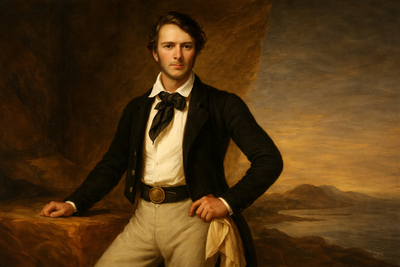
James Brooke: O Aventureiro que se Tornou o Rajá Branco de Sarawak
jan 26Nota do Autor: “Um homem pode moldar o seu próprio destino, mas primeiro precisa ter a coragem de zarpar.” - Anónimo Nas primeiras décadas do século XIX, quando o alcance do Império Britânico se estendia por oceanos e o mapa do Sudeste Asiático ainda era uma colcha de retalhos de sultanatos, territórios tribais e mares infestados de piratas, um homem esculpiu um reino próprio. James Brooke, um inglês nascido na Índia colonial, não era nem um soldado de carreira nem um estadista convencional. Contudo, através de uma mistura de audácia, diplomacia e pura persistência, ele se tornou o primeiro Rajá Branco de Sarawak, um governante numa terra distante do seu local de nascimento, governando um povo cuja língua e costumes ele teve de aprender desde o início. A sua história não é apenas de conquista, mas de transformação: um jovem inquieto, marcado por ferimentos e desilusões, que encontrou um propósito no mais improvável dos lugares. Início da Vida num Mundo em Transformação James Brooke nasceu a 29 de abril de 1803 em Secrore, perto de Benares (agora Varanasi), Índia, durante o auge da influência da Companhia Britânica das Índias Orientais no subcontinente. O seu pai, Thomas Brooke, era um juiz inglês ao serviço da Companhia, e a sua mãe, Anna Maria, filha de um nobre escocês. Os primeiros anos de Brooke foram moldados pelos cenários, sons e contradições da Índia colonial, um mundo onde a autoridade britânica coexistia desconfortavelmente com tradições ancestrais. Aos doze anos, foi enviado para a Inglaterra para estudar. A transição das paisagens vibrantes da Índia para a sobriedade cinzenta da Inglaterra foi chocante. Ele frequentou a Escola de Norwich e, mais tarde, o Colégio Militar Real de Sandhurst, mas doenças e lesões interromperam os seus estudos. Mesmo em jovem, era inquieto, atraído pela aventura e pelo romance de lugares longínquos. Vida Militar e Contratempos Em 1819, com apenas dezasseis anos, Brooke juntou-se ao Exército de Bengala da Companhia das Índias Orientais. A sua carreira militar inicial levou-o à Primeira Guerra Anglo-Birmanesa (1824-1825), uma campanha brutal travada nas selvas do Sudeste Asiático. Lá, foi gravemente ferido, uma lesão que pôs fim ao seu serviço ativo. Ao regressar a Inglaterra para recuperar, Brooke sentiu-se perdido. Tinha provado a emoção de terras distantes, mas estava agora confinado a uma vida mais calma. Contudo, a chamada do Oriente nunca o abandonou. Ele lia extensivamente sobre exploração e comércio, sonhando em regressar, não como soldado, mas como um aventureiro independente. O Chamado do Arquipélago Em 1834, Brooke tentou uma viagem comercial ao Arquipélago Oriental, mas esta terminou em desilusão. Sem se deixar abater, ele investiu a sua herança numa escuna, o The Royalist, e em 1838 zarpou novamente, desta vez com uma tripulação e um propósito mais claro. Ao chegar a Singapura, soube que Pengiran Muda Hassim, o primeiro-ministro do Brunei, estava a lutar para reprimir uma rebelião em Sarawak, um território na costa noroeste de Bornéu. Sarawak estava nominalmente sob o controlo do Brunei, mas assolado por agitação entre as populações locais Dayak e Malaias. Brooke ofereceu a sua assistência, trazendo o seu navio, os seus homens e o seu sentido de destino. A Gênese de um Rajá A intervenção de Brooke foi decisiva. Em 1841, a rebelião tinha sido esmagada e, em gratidão, Muda Hassim ofereceu-lhe a governação de Sarawak. No ano seguinte, o Sultão do Brunei confirmou formalmente a posição de Brooke, concedendo-lhe o título de Rajá. Assim começou o Rajado dos Brooke, uma singular experiência política na qual um aventureiro britânico governava um estado asiático como um monarca independente. Como Rajá, Brooke procurou impor a ordem. Trabalhou para reprimir a pirataria, que assolava os mares circundantes, e para travar a caça de cabeças entre as tribos Dayak. O seu governo combinou métodos administrativos britânicos com um respeito pelos costumes locais, granjeando-lhe admiração e suspeita. Poder, Desafios e Legado O reinado de Brooke não foi isento de controvérsia. As suas campanhas antipirataria geraram críticas na Grã-Bretanha, onde foi acusado de usar força excessiva. Foi investigado em Singapura, mas acabou por ser ilibado. Apesar destes desafios, manteve a sua autoridade e expandiu o território de Sarawak. Ele também enfrentou ameaças internas, revoltas e intrigas políticas no Brunei, mas através de diplomacia, determinação militar e carisma pessoal, ele manteve a sua posição. Quando regressou à Inglaterra em 1863, deixando o seu sobrinho Charles para governar, Sarawak tinha evoluído de um posto avançado problemático para um estado estável e internacionalmente reconhecido. Morreu em Devon em 1868, deixando uma dinastia que perduraria por um século. Comentário Reflexivo A história de James Brooke é de ambição, resiliência e do ponto de encontro desconfortável entre a visão pessoal e a política imperial. Ele não era um governador colonial típico nem um reformador puramente altruísta. O seu governo era paternalista, por vezes autocrático, mas marcado por tentativas genuínas de melhorar a vida dos seus súbditos. A vida de Brooke convida à reflexão sobre a natureza da liderança. Ele entrou num vazio de poder e preencheu-o com os seus próprios ideais, para o bem ou para o mal. O seu legado lembra-nos que a história raramente é linear: o herói de uma pessoa é o oportunista de outra. A verdadeira liderança emerge frequentemente no espaço entre a ambição e o serviço. A vida de Brooke mostra que a visão, a coragem e a adaptabilidade podem alterar o curso da história, mas que o poder acarreta sempre complexidade moral. Para a Sua Contemplação Pode a liderança nascida da ambição ainda servir o bem maior? Como julgamos figuras históricas que agiram em cenários morais diferentes dos nossos? É possível misturar o respeito pelas tradições locais com a governação estrangeira? O que significa “civilizar” aos olhos da história, e quem decide? Epílogo: A Esteira de um Rajá Branco A vida de James Brooke parece um diário gasto pelo mar, parte aventura, parte intriga política, parte busca pessoal. Desde o rapaz na Índia colonial com olhos irrequietos até ao soldado ferido em busca de um propósito, e ao homem que esculpiu um reino nas selvas fumegantes de Bornéu, a sua jornada foi tão imprevisível quanto as águas que navegou. Ele deixou para trás uma Sarawak para sempre mudada, uma dinastia que perduraria por um século, e um legado que ainda hoje suscita debate. Foi ele um reformador visionário, um autocrata benevolente, ou simplesmente um homem que agarrou uma oportunidade e se recusou a largá-la? Talvez ele tenha sido tudo isso ao mesmo tempo. O que é certo é que a história de Brooke nos lembra que a história é moldada não apenas por impérios e exércitos, mas por indivíduos dispostos a ir além do mundo conhecido e a apostar as suas vidas num sonho. No fim, o Rajá de Sarawak não foi apenas um governante de terras, mas um navegador da possibilidade humana, traçando um curso entre culturas, ambições e as marés do seu próprio tempo.
-
Episódio · 1 · A Costa Antes dos Nomes
jan 26Notas do Autor: Antes que os navios carregassem bandeiras e cruzes, antes que os mapas pregassem nomes em água e costa, existiam lugares que só respondiam à maré, ao recife e à memória. A ilha de Mactan, ou como era chamada naquela época, Mangatang, era um deles. Posicionada em frente a Sugbo, a atual Cebu, é onde esta história começa. Aqui, o poder não se anunciava. Ele se revelava lentamente, através do silêncio mantido no momento certo, através de decisões tomadas antes que os outros percebessem que existia uma escolha. Este não é o começo de uma batalha. É o início de uma pressão, sentida primeiro por aqueles que sabem ouvir. _________________________________________________________ O mar tinha humores, assim como os homens. Ao amanhecer, ele jazia plano e brilhante como estanho martelado, como se nunca tivesse conhecido a fúria. Pelo meio da manhã, respirava, levantando-se em ondas lentas que empurravam as canoas com estabilizadores e faziam os rapazes praguejar suavemente enquanto firmavam as cestas de mariscos. À noite, podia se tornar uma garganta que engolia a luz. Você poderia viver toda a sua vida à sua beira e ainda assim acordar às vezes com o coração disparado, convencido de que o tinha ouvido chamar seu nome. Lapu-Lapu estava onde o coral quebrado dava lugar a escombros e depois à areia, as primeiras palmeiras inclinando-se para a água, observando a maré escoar das águas rasas. O recife mostrava os seus ossos. Manchas de rocha negra quebravam a superfície como nós dos dedos. Os canais, os seguros, marcavam-se em fitas mais escuras onde a água corria mais fundo, onde um barco podia deslizar sem rasgar o seu ventre. Ele conhecia esses canais como conhecia suas próprias cicatrizes. Não de uma só vez, mas pela memória de dor e sobrevivência sobrepostas ao longo do tempo. Atrás dele, o barangay se agitava. Fumaça subia das fogueiras em colunas finas e pacientes. Cães moviam-se entre as cabanas como ladrões, focinhos baixos, rabos a abanar, esperando por uma gota de caldo ou uma tira de pele de peixe. Crianças perseguiam-se pelos postes das casas elevadas, o riso agudo e súbito, como pássaros atirando-se para o ar. Uma mulher chamava por elas, não com força suficiente para as parar, apenas para lhes lembrar que ela existia. Os homens já estavam acordados, os que valiam a pena. Os que se levantavam sem serem chamados. Os outros acordavam mais tarde, quando as suas mulheres os chutavam, ou quando a fome os fazia mover. A utilidade de um homem mostrava-se cedo no dia. Uma canoa entrou baixa e rápida pelo canal, seu estabilizador batendo na ondulação. Dois homens remavam; um terceiro agachava-se na proa com uma lança pousada nas coxas, como se esperasse que o próprio mar se levantasse e o enfrentasse. A canoa encalhou na areia com um arranhão que se propagou mais longe do que devia. Lapu-Lapu não se moveu para os cumprimentar. Um líder que corria para cada chegada ensinava às pessoas que o seu tempo era barato. Um líder que esperava fazia com que os outros entrassem na sua órbita, na sua gravidade. O proeiro saiu primeiro, água até aos joelhos, e arrastou a canoa mais para cima. Era jovem, de ombros largos, ainda carregando o entusiasmo dos homens que ainda não tinham aprendido que o mundo não o recompensava. Um dos remadores levantou um saco tecido do casco e segurou-o com ambas as mãos, não acima da cabeça, nem escondido. Uma oferenda devidamente apresentada. O remador mais velho deu um passo à frente, olhos baixos, e parou no limite dos escombros de coral onde a sombra de Lapu-Lapu caía. “Datu,” disse o homem, a palavra carregada, intencional. Lapu-Lapu deixou o silêncio se estender. Olhou para as mãos do homem. Ásperas, rachadas de sal, fortes. Não as mãos de um homem da corte. Não um homem que vivia apenas pela fala. Um homem em quem se podia confiar para segurar um remo durante uma tempestade, ou uma lâmina através do sangue. “O que o traz a esta hora?” perguntou Lapu-Lapu. “Notícias do canal norte”, disse o remador. “E peixe, antes que o sol o aqueça.” Ele pousou o saco e desamarrou-o. O cheiro subiu imediatamente. Cavala fresca, prateada e lisa, os olhos ainda claros. Um bom presente. Não um suborno. Um sinal de respeito e urgência em igual medida. Lapu-Lapu assentiu uma vez, aceitando o peixe sem estender a mão para ele. “Fale.” “Navios passaram ontem”, disse o homem. “Três deles. Não do nosso lado. Não de Sugbo. Demasiado grandes para os mercadores que conhecemos. As velas eram altas e brancas, como o ventre de um peixe.” Lapu-Lapu manteve o olhar no mar, mas algo se apertou por detrás dos seus olhos. Barcos grandes existiam. Barcos que transportavam homens que não pertenciam aos ritmos dos recifes e das marés. As pessoas gostavam de falar do mundo vasto como se fosse uma história infantil, mas o mundo era real. O vento não parava no limite de Mangatang. “E?” ele disse. “Havia fumo esta manhã”, continuou o remador. “Dos manguezais ocidentais. Espesso. Um fogo feito para ser visto.” Lapu-Lapu virou a cabeça finalmente. Fumo nunca era acidental. “Quem vigia aquela costa?” ele perguntou. “Dois dos seus homens. Três dos meus.” “Traga-me um”, disse Lapu-Lapu. “Agora.” O alívio passou rapidamente pelo rosto do remador. Ele tinha cumprido a sua missão. O peso passava para outro lugar. Quando a canoa se afastou novamente, Lapu-Lapu permaneceu onde estava, observando os remos morderem a água, observando os homens entrarem no ângulo do canal que só aqueles criados ali conseguiam ver. Um líder não temia as notícias. Ele temia o dia em que ninguém as trouxesse. Passos arrastaram-se atrás dele sobre os escombros de coral. Pesados. Calmos. Lapu-Lapu não se virou. Ele conhecia o som de cada homem sob o seu teto. Kumpar aproximou-se dele, cabelo puxado para trás, peito tatuado marcado com linhas pálidas que assinalavam lutas antigas e sobrevivências ainda mais antigas. Ele cheirava a fumo e a suor velho. “Você ouviu”, disse Kumpar. “Eu ouvi.” “Fumo dos manguezais é Zula”, disse Kumpar. “Ele quer que você vá.” “Ele quer que eu responda”, respondeu Lapu-Lapu. “Isso não é a mesma coisa.” “Se ele reunir homens, ele se gabará de que você não fez nada.” A boca de Lapu-Lapu curvou-se ligeiramente, sem humor. “Se eu for a todos os seus alardes, torno-me o seu cão. Deixe-o ladrar.” Ele enviou observadores para oeste. Não para lutar. Para ver. Depois, voltou-se para o barangay. Lâminas estavam a ser afiadas. O som de pedra no metal era íntimo, quase privado. Os homens paravam ao ele passar, lendo a sua postura, a posição dos seus ombros. Eles saberiam até ao meio-dia se haveria sangue. Dentro da sua casa, o ar estava mais fresco. Uma mulher estava deitada no tapete, sem se esconder, sem medo. Ela virou a cabeça quando ele entrou, como se o próprio espaço tivesse mudado. Ela não perguntou onde ele tinha estado. Essa pergunta pertencia a pessoas que temiam respostas. Eles deitaram-se juntos sem cerimónia. Não era fuga. Não era indulgência. Continuação. Lá fora, a ilha seguia em frente, indiferente ao que estava a tornar-se. Mais tarde, ela traçou linhas ociosas na sua pele. “Você está a ser medido”, disse ela. “Eu sempre sou.” “Não como desta vez.” Ela levantou-se e desamarrou um pequeno embrulho de um pino, entregando-lhe um cordão tecido escuro. “Para o seu pulso.” “Um amuleto?” “Um lembrete”, disse ela. “Quando falar, lembre-se do que você quer. Não do que eles querem arrancar de você.” Ele amarrou-o. O cordão mordia levemente a sua pele. Dor útil. “Você deve comer”, disse ela. “E você irá ao babaylan.” Ele não gostava de ser predito. “Sim”, disse ele. Ela saiu. A casa instalou-se na sua própria forma. Lá fora, o barangay continuava a respirar. O barulho tinha mudado. Não estava mais alto. Estava mais agudo. A costa ainda não tinha nomes que o mundo se lembraria. Mas já estava a ser pesada. — O fumo traçou a primeira linha. As palavras traçariam a próxima. Antes que o dia terminasse, Lapu-Lapu entraria num círculo onde o silêncio respondia, e onde o futuro não pedia permissão antes de falar. Continua…. __________________________________________________________ Termos Alipin – Uma pessoa dependente ou ligada; o estatuto variava e não era equivalente à escravidão chattel colonial posterior. Anito – Espíritos ou seres ancestrais que se acredita influenciarem o mundo dos vivos. Babaylan – Um especialista ritual, curandeiro e autoridade espiritual. Bahay kubo – Uma habitação tradicional palafitada feita de madeira e bambu, com telhado íngreme de folha de nipa e beirais estendidos. Balangay – Um grande barco de madeira usado para comércio, viagens e guerra. Barangay – Um assentamento ou comunidade costeira. Datu – Um chefe local cuja autoridade reside na linhagem e no poder. Mangayaw – Um ataque ou expedição realizada para prestígio ou obtenção de cativos. Sandugo – Um pacto de sangue usado para selar alianças ou acordos. Nomes e Lugares Bohol (Bool) – Uma ilha a leste, conhecida nos tempos pré-coloniais como Bool. Cartagena – Uma figura estrangeira cuja presença sinaliza a expansão da influência externa. Hara – Uma mulher próxima de Lapu-Lapu, oferecendo conselho e estabilidade. Kumpar – Um guerreiro mais velho no séquito de Lapu-Lapu. Lapu-Lapu – Datu de Mangatang, conhecido pela sua independência. Leyte (Tandaya) – Uma ilha historicamente referida como Tandaya. Mangatang – A ilha mais tarde conhecida como Mactan. Mayumi – Uma mulher cujos relacionamentos afetam alianças e tensões. Si Gama – Um capitão estrangeiro conhecido primeiro através de rumores e relatórios. Sugbo – Um poderoso assentamento vizinho, a atual Cebu. Zula – Um datu rival que reivindica influência ao longo da costa ocidental de Mangatang. Sandugo – Um pacto de sangue usado para selar alianças ou acordos. Mangayaw – Um ataque ou expedição realizada para prestígio, vingança ou obtenção de cativos. Anito – Espíritos ou seres ancestrais que se acredita influenciarem o mundo dos vivos.